Collarless short-sleeve shirts are back in the summer 2026 menswear mix: the cleanfit and campus layer worth buying after Chinese trend signals, shop naming, and real-life styling
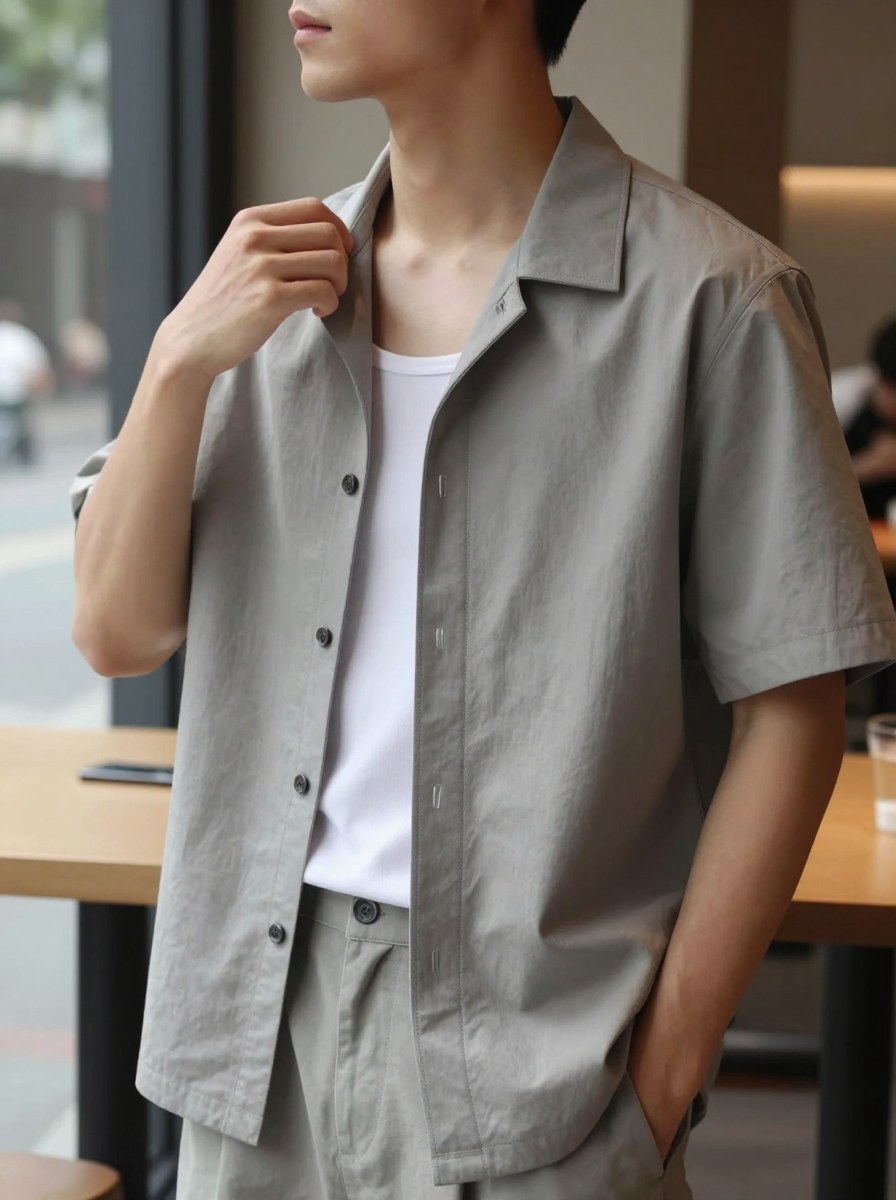
If you break down the latest spring-summer menswear signals across the Chinese internet, one change stands out clearly. People are still talking about knit polos, white tees, lightweight denim, cooling shirts, baseball shirts, training shorts, and every kind of cleanfit basic—but another piece has quietly moved back into the frame: the collarless short-sleeve shirt.
It matters again not because the name suddenly became new, but because the way Chinese platforms read it has changed. In Xiaohongshu-style headlines, Taobao and Tmall product naming, and Bilibili or short-video menswear discussions, you keep seeing the same language clustering together: collarless, band collar, easy open shirt, linen blend, drape, relaxed mood, light commuting, college-boy dressing, cleanfit, summer lightweight shirting, air-conditioned layering, worn over a white tee. Put together, those phrases point to one thing: people are not looking for a dramatic designer shirt. They want a light structural layer that takes summer upper-body dressing from “just a T-shirt” to “this looks intentionally put together.”
That is exactly where the collarless short-sleeve shirt lands. It is lighter and less formal than a standard collared short-sleeve shirt, easier to wear open than a knit polo, cooler than a light jacket, and far more useful than a plain tee when you want a sharper upper-body outline. In practice, it works as a half-shirt, half-overshirt, half-structure piece that fits the strongest 2026 Chinese-youth-menswear lines without pushing the wearer into costume territory.
1. Why it works right now
The strongest youth-menswear direction on the Chinese internet is no longer built on oversized branding, heavy streetwear, loud prints, or aggressively designed pieces. It is built on a more realistic set of priorities: lightness, cleanliness, wearability, commuting ease, campus credibility, and the ability to move between ordinary daily settings. Once that becomes the baseline, the question changes from “what top is the loudest?” to “what top quietly gives the outfit structure?”
That is the context in which collarless short-sleeve shirts make sense again. For a long time, many versions on the market failed in two ways: they were either too thin and too close to cheap uniform shirts, or too niche and symbolic to fit normal wardrobes. The stronger current version across Chinese menswear shopping and styling language is different. It is looser in fabric, straighter in cut, cleaner around the neck, calmer in button treatment, lower in saturation, and much closer to a summer overshirt than to a corporate short-sleeve button-up.
This lines up perfectly with the Chinese-internet rewrite of “college boy,” “relaxed mood,” and “light commuting.” People want clothes that work in libraries, subways, cafés, classrooms, malls, weekend walks, and casual dates—not just in content-photo situations. The collarless short-sleeve shirt is unusually good at staying in that zone. It does not push too hard into vacation-shirt territory, officewear, or tactical styling. It gives youth menswear something rarer: cooling power, extra structure, and a cleaner outline at the same time.
Chinese-internet signals behind this rise
2. The style lines where it actually belongs
The collarless short-sleeve shirt is only good when it is placed in the right menswear language. It does not belong to heavy workwear, loud streetwear, or mature authority dressing. For BoyStyle’s youth-oriented world—softboy, cleanfit, campus dressing, light Korean and Japanese casualwear—it fits best in these lanes.
1. Campus cleanfit: it fills the upper-body gap between a white tee and straight trousers
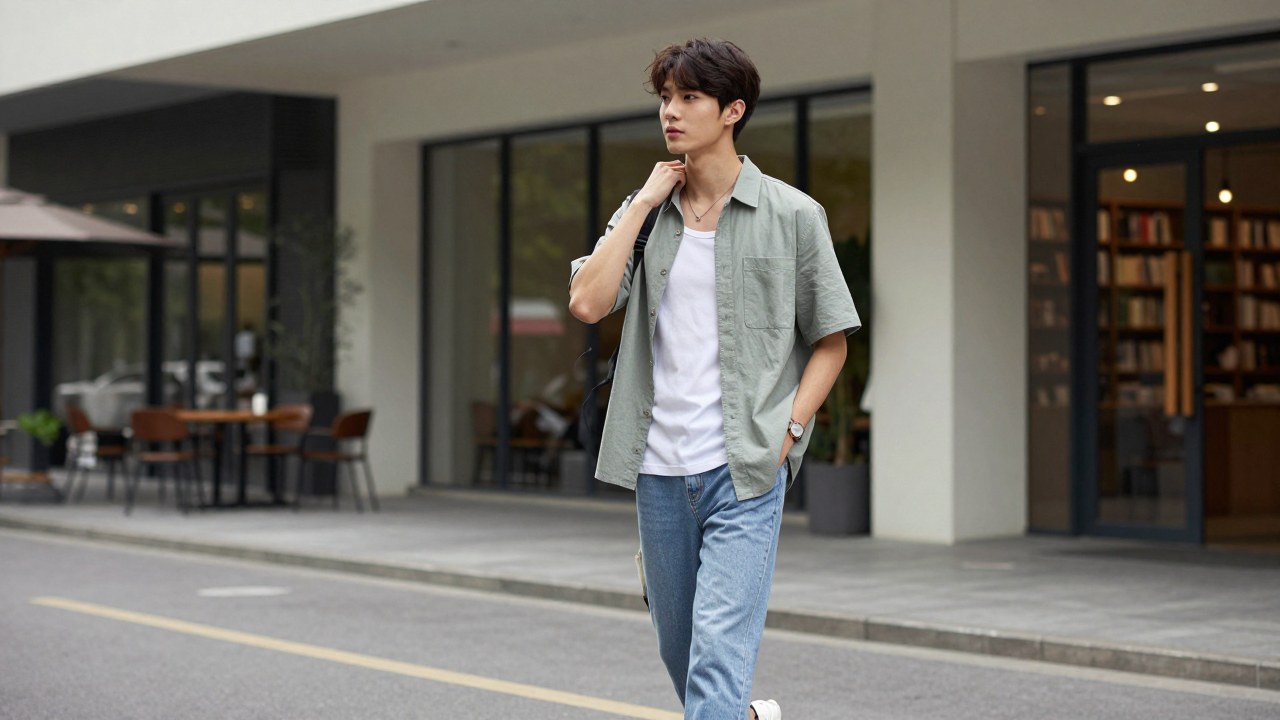
A lot of campus outfits fail not because the trousers or shoes are wrong, but because the upper half is too direct. White tee on, trousers on, bag on—fine, but not really styled. Worn open over a tee or tank, a collarless short-sleeve shirt adds a line of placket, shoulder shape, and a little visual depth. Because it drops the standard collar, it also loses a lot of office energy.
2. Light commuting: cooler than a knit polo, more complete than a tee
If you already follow light commuter cleanfit wardrobes, you know the best pieces are not always expressive—they are flexible. Collarless short-sleeve shirts work with straight trousers, drawstring pants, pale denim, nylon commuter pants, trainer shoes, canvas shoes, loafers, and simple sandals. They bridge the gap between a too-basic tee and a too-structured shirt.
3. Light Japanese or Korean casualwear: perfect for low-saturation summer palettes
If your wardrobe already lives in pale grey, oatmeal, fog blue, charcoal, soft white, and washed khaki, this shirt category fits in naturally. Linen blends, cotton-linen, and softly draping summer fabrics make the best versions. That is why the item sits so comfortably between Japanese casualwear and lighter Korean styling: it looks like a shirt, but functions more like a breathable summer layer.
3. The four versions actually worth buying
Chinese e-commerce folds very different products under the same search term. Some are symbolic stand-collar shirts, some are uniform-adjacent pieces, some are very thin cooling shirts, and some actually fit cleanfit youth menswear. For most readers, these four directions are the most useful.
1. Linen-blend collarless short-sleeve shirts
This is the first category I would recommend. Linen-blend versions are usually the easiest place to find breathability, low pressure, and relaxed shape. They do not need to be pure linen; cotton-linen and soft linen-look blends are fine if they avoid shine and cheap stiffness. The safest colors are off-white, oatmeal, pale grey, fog blue, washed khaki, muted green, and charcoal.
2. Soft drapey versions in lightweight synthetic or blended fabrics
If you dislike the visible creasing of linen and want a cleaner, sharper line, look for versions marketed around drape, cooling feel, lightness, or easy commuting. Their strength is smoother plackets, easier shoulder drop, and a cleaner pairing with straight trousers. Their danger is obvious too: too shiny, too slippery, too close to the body, and they fall straight into cheap-uniform territory.
3. Slightly boxy cuts
The best collarless short-sleeve shirts are rarely slim. In current Chinese youth-menswear language, the strongest cut is usually a slightly roomier boxy fit with relaxed shoulders, controlled length, and a hem that does not drag low. That is the version that works best over a white tee base, with drawstring trousers, pale denim, and simple commuter bags.
4. Quiet-detail versions
Most failures happen because the details are too loud: oversized patch pockets, heavy plackets, thick buttons, overdone texture, too many design seams, too much length. The best current version does the opposite: small clean buttons, minimal placket drama, little or no pocket weight, soft texture instead of loud texture, and a proportion that stays close to the upper hip. It sells order, not costume.
4. What to judge in product images
- Check the shoulder line first. Too stiff and the shirt turns corporate; a gentle shoulder drop is much closer to 2026 cleanfit youth styling.
- Check the neck and placket. Collarless should still feel intentional. Good versions keep the edge clean so the neckline transitions naturally into the inner layer.
- Check the body length. Too long feels old and heavy; too short feels flimsy. Mid-hip-ish balance is the safest zone.
- Check sleeve length and sleeve opening. Too long and narrow gets stuffy fast. A slightly shorter, easier sleeve reads much fresher.
- Check for shine. Excess shine is the fastest way into cheap cooling-uniform territory.
- Check whether the store ever shows it worn open. If every photo is buttoned up, the overshirt logic may be weak.
- Check the bottoms in the product styling. Stores that really understand the piece usually pair it with white tees, tanks, straight trousers, drawstring pants, pale denim, and simple sneakers or canvas shoes.
- Check the color restraint. Off-white, pale grey, charcoal, fog blue, and washed khaki are safer than louder, darker, or more saturated choices.
5. Five buying directions worth prioritizing
Product directions and public search entry points
6. The seven most common mistakes
- Too slim. That sends the whole shirt back into officewear.
- Too thin and too transparent. If it barely holds shape, it will not work as a real layer.
- Too shiny. This is where many “cooling” versions collapse.
- Too long. That drags the whole silhouette down and adds age.
- Too many pockets or technical details. That pushes it toward uniform or utility logic instead of cleanfit calm.
- A badly handled neckline. Some pieces look like someone just cut the collar off a regular shirt.
- Stores that only style it with dress trousers and leather shoes. That usually means they understand it as mature officewear, not youth-oriented summer shirting.
7. BoyStyle’s take
I do not think the collarless short-sleeve shirt is just a short-lived keyword wave. It feels more like the natural next step once white tees, tanks, knit polos, drawstring trousers, straight pants, and easy shoes have already become stable parts of Chinese youth menswear. The next question is always: what is the lightest structural layer that can complete the upper body? This shirt answers that question unusually well.
It is not about looking dramatically fashionable. It is about having one more summer top that feels easy but noticeably more complete than a plain tee. For campus cleanfit, light commuting, softer Korean styling, and lighter Japanese casualwear, that is a very practical upgrade. You do not need to rebuild your whole wardrobe. You just need one piece that gives the upper half more finished shape.
If you only want to add one genuinely useful light summer top this season, I would put the collarless short-sleeve shirt very high on the list. The key is not buying just any version, but the right one: slightly relaxed cut, matte fabric, calm color, clean neck treatment, and product images that prove it can work both buttoned and open over a white tee.
Read next: Why knit polos are becoming one of the strongest cleanfit tops, Why cooling summer shirts keep rising in 2026, Why the white tee still matters most in youth menswear, and How to build a light commuter cleanfit wardrobe that stays sharp without becoming dull.
Chinese-internet signal reference pattern: based on recent Chinese-platform naming and discussion paths around collarless short-sleeve shirts, band-collar summer shirts, “what to wear over a white tee,” summer college-boy tops, light commuting shirts, linen-blend shirting, and relaxed cleanfit layers; also informed by product-title patterns commonly used across Chinese e-commerce such as linen, cotton-linen, drape, lightness, cooling, overshirt, commuter, Korean-inspired, Japanese-inspired basics, and “wearable for men,” plus Bilibili and short-video framing around “what to wear besides a T-shirt,” “how to wear short-sleeve shirting without looking old,” and “what makes a summer outfit look intentional.” Public entry examples include Taobao: men collarless short-sleeve shirt, Taobao: men band-collar short-sleeve shirt, and Bilibili: men short-sleeve shirt styling.