Why the grey hoodie is back at the center of 2026 campus-boy and cleanfit basics
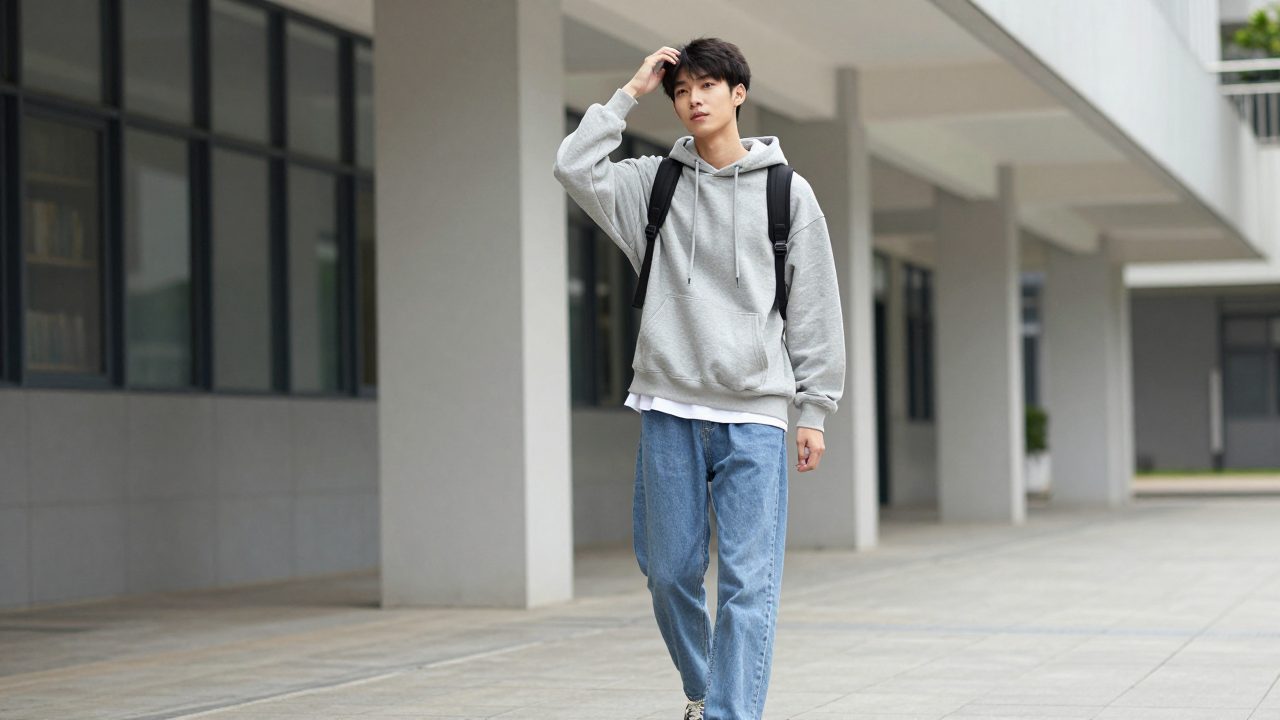
If you have been following Chinese-internet menswear recently, one comeback is easy to spot. People still talk about campus-boy style, cleanfit, light Korean casual dressing, commuting looks, and what to wear to class or the library, but many of the strongest purchase signals have shifted away from louder outerwear or more obvious trend labels and back toward grey hoodies, light-grey zip hoodies, heavyweight basics, and repeatable hooded mid-layers.
That matters not because hoodies are new, but because the need around them has changed. A lot of younger dressers no longer want hoodies mainly for giant logos, streetwear energy, or exaggerated shapes. In 2026, the Chinese-internet demand is much more about a piece that can connect white tees, denim, straight trousers, light jackets, canvas bags, and daily commuter scenes. The grey hoodie lands exactly there. It has more presence than a white tee, more ease than a cardigan, more repeat value than a graphic sweatshirt, and more real wardrobe usefulness than a purely athletic top.
1. Why the grey hoodie, specifically, moved back to the center
Across Xiaohongshu-style titles, Bilibili outfit videos, Taobao product naming, and Douyin product language, recent repetition matters: “campus grey hoodie,” “light-grey hooded sweatshirt,” “cleanfit hoodie,” “heavyweight hoodie basic,” “zip hoodie mens,” and “campus commuter sweatshirt.” Put together, the signal is clear. People are not just shopping for warmth. They want a basic layer that can bring ease and completion to ordinary outfits at the same time.
Grey works especially well because it fits the current Chinese-internet visual preference almost by default. The strongest youth menswear right now is less about loud color, louder logos, and obvious styling performance, and more about lower saturation, believable daily use, and outfits that feel like real life rather than a one-off photoshoot. A grey hoodie sits right inside that logic. It comes from sportswear, but no longer reads as purely athletic. It has streetwear history, but now gets worn in a cleaner way. It still keeps student energy, but does not have to feel childish. For campus-boy, cleanfit, and light Korean casual wardrobes, it crosses a lot of categories without fighting any of them.
Chinese-internet signals behind the return of the grey hoodie
2. It solves the missing middle layer in a lot of basic outfits
White tees matter. Shirts matter. Cardigans and light jackets matter too. But many young dressers do not actually suffer from a lack of clothes. The real problem is often the lack of a layer that connects the upper and lower halves cleanly. A tee alone can feel too bare. Going straight to a jacket can feel too intentional. Shirts and knits can sometimes feel a touch too polished for ordinary daily life. The grey hoodie fills that middle space unusually well.
Its strength is that it works alone and as a mid-layer. Worn by itself, it gives the outfit a fuller upper-body shape. Layered, it places a natural volume between a tee and an outer layer. Light grey, misty grey, and marl grey all help because they are less harsh than black and less attention-seeking than brighter colors. For cleanfit and campus-boy wardrobes, that present but quiet quality is extremely useful.
You can think of the grey hoodie as a wardrobe buffer. It makes denim feel more complete, softens the harder edge of straight black trousers, helps nylon crossbody bags and canvas totes blend into the outfit more naturally, and gives jackets something better to sit on. A lot of Chinese-internet youth menswear that currently looks “right” does not succeed because each item is spectacular. It succeeds because the middle-layer logic is handled well.
3. Why it is more worth prioritizing than graphic, colorful, or pure-black hoodies
There are obviously many hoodie options, but if you only want to buy one that you will actually wear often, the grey hoodie is still the safer and stronger first move.
- More repeatable than a graphic hoodie: large graphics and logos can feel exciting at first but quickly narrow your outfit routes. A plain grey hoodie can be worn again and again without fatigue.
- Easier to integrate than a colorful hoodie: most campus-boy and cleanfit wardrobes already lean on white, grey, blue, khaki, black, brown, and olive. Grey fits in without forcing the rest of the wardrobe to adapt.
- Lighter than a pure-black hoodie: black is reliable, but in this current lower-aggression, more campus-oriented mood, grey feels softer and more believable.
- More aligned with current taste than an exaggerated oversized hoodie: people still like ease, but no longer need maximum exaggerated volume. The current target is relaxed without looking inflated.
In other words, what is returning is not “the hoodie” in a general sense. It is the grey hoodie returning to its correct job: not as a trend proof-point, but as a basic wardrobe structure that organizes daily dressing.

4. What to check before buying a grey hoodie
1. Check the tone of grey before the branding language
The most common failure is not price. It is the wrong grey. A cold bluish grey can feel cheap, and a very dark almost-black grey can lose the lighter mood this category currently needs. The safer zone is a middle or lighter grey with some marl texture and a slightly softer cast.
2. The hood should hold shape without becoming huge or dead-flat
On a hooded sweatshirt, the hood itself matters a lot. Too thin and flat, and the whole piece feels lifeless. Too huge and heavy, and it can visually swallow the wearer. The ideal hood keeps some body at the back of the neck and still looks natural when worn up.
3. Shoulders should fall naturally
A lot of weaker hoodies fail at the shoulder and armhole. They either cling too much or explode outward awkwardly. The better versions for campus-boy and cleanfit dressing have natural shoulder fall, some chest room, and no unnecessary bulk.
4. The hem and ribbing need a real boundary
If the hem is too loose, the hoodie starts to feel like worn-out homewear. If it clamps too hard, the body shape becomes short and tense. The best result has a visible edge without squeezing the body.
5. Better slightly substantial than thin and floating
The hoodies that currently read strongest usually mention weight and structure for a reason. They do not have to be extremely heavy, but they should not be so thin that they collapse onto the body and expose every fold and underlayer line.
6. Keep pockets and details clean
A kangaroo pocket is fine. But too many zips, contrast cords, metal details, or panel lines can drag the hoodie away from “basic layer” and back toward “statement item.” If you want repeat value, restraint wins.
7. Ask if it works with the trousers and bags you already wear
Before buying, picture it with your denim, straight trousers, nylon pants, sweats, tote bags, sling bags, and campus backpacks. If it only works with one pair of trousers, it is not really a basic.
8. Product pages must show full on-body fit
Hoodies are highly shape-dependent. Flat-lay photos are not enough. Good shops should show the front, side, hem, hood shape, and how the hoodie sits with denim or under outerwear. If a listing gives only close-ups and mood shots, it is probably selling concept rather than fit.
Shopping routes
5. The four outfit routes where it works best
- Grey hoodie + light blue jeans: the classic campus-boy route. Simple, repeatable, and strongly tied to youth everyday dressing.
- Grey hoodie + black straight trousers: cleaner and more city-oriented, with the grey softening the harder edge of black trousers.
- Grey zip hoodie + white tee + nylon crossbody bag: ideal for the class-to-library-to-commute scenes that appear constantly in Chinese-internet styling.
- Grey hoodie + light jacket or short outer layer: one of the most stable mid-layer roles it can play, especially in spring.
The real strength of the grey hoodie is that it does not need lots of accessories or dramatic styling to make someone look more put together. That is exactly why it has moved back into the center of 2026 basics.
6. Who should buy one first
- People who already own white tees, denim, and straight trousers but still feel their outfits lack completion.
- People who want campus-boy, cleanfit, or light Korean casual dressing without relying on heavy outerwear or too many accessories.
- People moving constantly between class, the library, short commutes, and weekend plans who need one genuinely high-frequency basic layer.
- People who tried graphic or colorful hoodies and realized they keep drifting back toward quieter, lower-saturation clothes.
It is not the loudest item in the wardrobe, but it may be one of the smartest basics to buy well again in spring-summer 2026. The deeper shift behind it is simple: a repeatable, natural, real-life-friendly layering piece matters more than a single item whose only job is to look fashion-aware.
Read next: Why the heavyweight white tee still anchors a youth menswear wardrobe, Why campus-boy dressing keeps returning, Why nylon crossbody bags now own the commuter layer, and Why short light jackets returned as a key outer layer
Source references: Xiaohongshu: grey hooded sweatshirt mens, Bilibili: grey hoodie campus-boy styling, Taobao: grey hooded sweatshirt mens, Douyin: grey hoodie mens styling