# Why the campus-boy look has become one of the most stable style languages in Chinese youth menswear
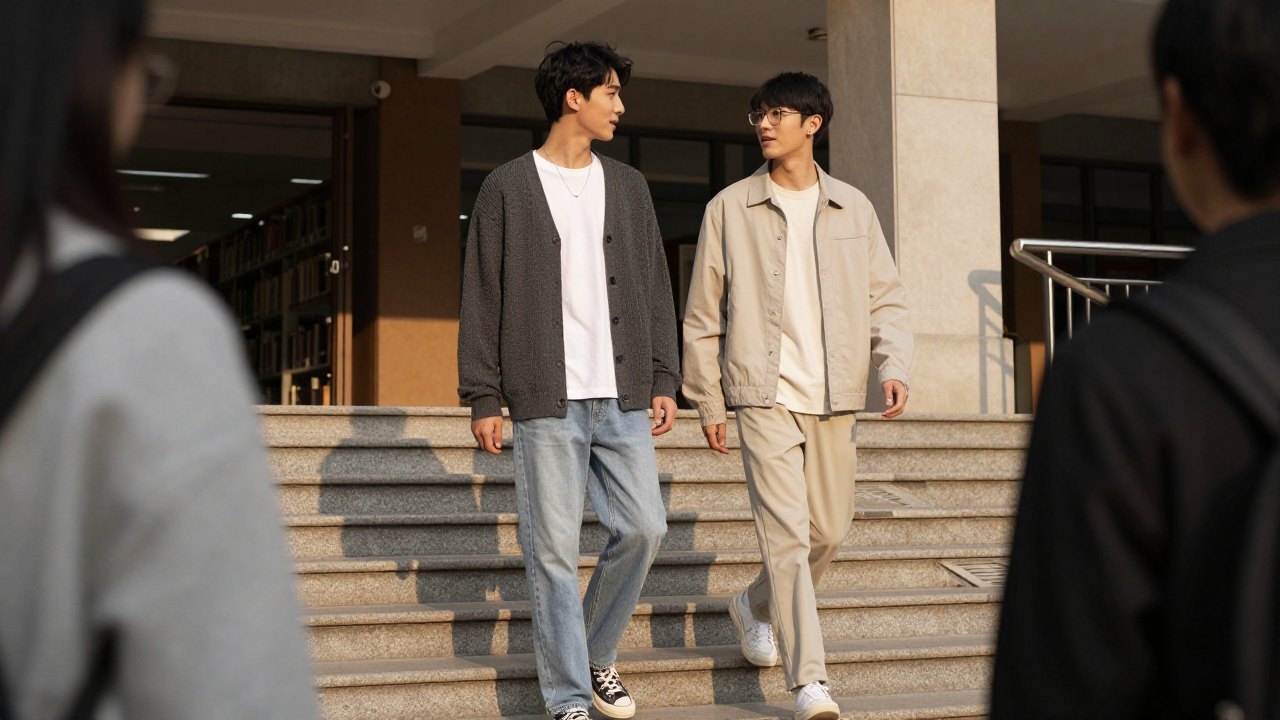
This image at least shows actual contemporary youth menswear on body: a loose white tee, multiple trouser pairings, and a silhouette closer to everyday campus and commuter dressing.
The campus-boy look is not rising again because everyone suddenly wants to dress like a student. It works because it compresses several difficult menswear problems into one relatively stable answer: do not look too mature, do not look too expensive, do not look too aggressive, but still look clean, relaxed, and believable on a real young person moving through campuses, subways, and ordinary city life.
More accurately, people are not returning to this look because they want to perform “student energy.” They are returning to it because it offers one of the safest real-life youth silhouettes: not too mature, not too trend-chasing, not too expensive, but still clearly considered.
The formula usually depends on a few recurring elements: a loose but not sloppy silhouette, light or low-saturation colors, softer upper-body pieces such as cardigans or hoodies, straight trousers or relaxed pants, and an overall tone that looks effortless without looking unfinished.
## The core is not “student energy” but a highly repeatable silhouette
A more useful way to understand the look is this: it gives young menswear one of its safest and most repeatable proportions.
- keep the upper half soft rather than harsh
- keep the lower half straight or relaxed rather than skinny
- keep colors calm rather than loud
- make sure the items can work with each other easily
That is why cardigans, hoodies, knitwear, white tees, straight trousers, and relaxed denim keep returning to this space. They are not the most dramatic pieces, but they are among the easiest ways to build an outfit that still feels real.
## Four recurring visual formulas behind the campus-boy look
What stabilizes this style is not a single label but a few repeated outfit patterns. Most Chinese-internet looks that feel believable in this lane can be broken back into some version of the combinations below.
### 1. Cardigan + white tee + relaxed trousers
This is the safest route. The upper half stays soft, the lower half stays clean, and the whole outfit feels friendly, calm, and easy to repeat from spring into air-conditioned interiors and early summer.
### 2. Light jacket + straight trousers + sneakers
This line leans a little more toward subway commuting, library time, and ordinary city movement. It feels more complete than a hoodie but lighter than a heavy jacket, which makes it perfect for people who want to push the style slightly toward light commuter menswear.
### 3. Knit polo + straight trousers or jeans
This is one of the strongest late-spring and early-summer formulas right now. It is not the mature business-polo route. It is a softer, lower-aggression collared top logic that sits perfectly between campus-boy dressing and cleanfit.
### 4. White tee or shirt + canvas bag or sling bag
Many people treat the bag as a side detail, but in this style space it often decides whether the outfit still feels like believable young menswear or suddenly slides too far into officewear, streetwear, or staged e-commerce styling.
## Product choice matters more than the style label itself
The easiest way to fail at this look is to memorize the label but buy the wrong products. Chinese platforms are full of terms like campus style, softboy, cleanfit, boyfriend style, or Japanese/Korean casual, but many of the actual products behind those labels are too cheap-looking, too costume-like, or simply not useful in everyday wear.
That is why BoyStyle should not stop at style explanation. It also needs product entry points: what kind of cardigan is safest, what kind of trousers produce the right line, which stores really work in this aesthetic, and what product images immediately signal that a listing is on-topic or off-topic.
## Three kinds of pieces that most easily go wrong
### 1. Overly slim tops
The campus-boy look does not benefit from tops that grip the shoulders, chest, and arms too tightly. That usually makes the whole outfit feel stiff, older, and too eager.
### 2. Cheap-looking listings with lots of mood but poor real fit
Some product pages are good at selling atmosphere while failing on shoulder line, length, trouser shape, or fabric quality. This look does not fail because it is “simple.” It fails when the quality signals collapse.
### 3. Pieces that feel too much like costume academia
If a piece looks more like a uniform prop than something a real person would wear on a real day, it usually does not belong in this wardrobe for long. The point is not cosplay. The point is a low-risk, believable youth proportion.
## How to move from style words to actual shopping routes
What makes college-boy style persuasive is not a single item, but the overall rhythm of two believable young figures moving through real campus space.
Product leads
Plain low-saturation cardiganA reliable soft entry point for the upper body. Start with off-white, grey, navy, or light brown. Check shoulder line, body length, and button density first; if the cut is too slim or the knit too thin, the whole look becomes much weaker.
Straight-leg trousersA cleaner and more current youth proportion than skinny trousers, especially for cleanfit and campus looks. Check whether the leg actually falls straight and whether the length is natural; too narrow or too short ages the outfit immediately.
Minimal backpack or canvas bagAccessories work better when they stay close to an actual student-commuting context instead of heavy hypewear styling. Look first at size, silhouette, and logo restraint; overly technical, exaggerated, or office-coded bags usually miss the point.