Basics / summer inner layer
Non-sheer base-layer tees are taking over the 2026 summer upper-body foundation: from Chinese-internet trend signals to white-shirt layering, cool lightweight inner tees, and one of the smartest additions for college-boy cleanfit wardrobes
Across recent Chinese-internet menswear discussion, one of the most practical but still underwritten shifts is this: people are no longer only choosing the visible short-sleeve top. They are returning to a deeper and more useful question — what should sit under a white shirt, pale open shirt, thin knit, or lightweight summer overshirt so the whole upper body feels cleaner, less sheer, and less stuffed? That is why terms like “non-sheer base tee,” “white-shirt undershirt,” “invisible inner tee,” “cool lightweight inner tee,” “summer undershirt for men,” “commuter base-layer tee,” and “cleanfit inner tee” are rising together across Xiaohongshu-style titles, Taobao listing language, Bilibili no-mistake-buying content, and Weibo-style discussion.
This topic matters not because the base-layer tee itself is new, but because it has regained a very specific wardrobe role in summer 2026. For a long time, men’s summer innerwear tended to split into two weak extremes: either a normal white tee got forced under everything, making light shirts feel thick, hot, and crowded around the neck, or nothing was worn underneath at all, leaving pale shirts too sheer and too direct. Current Chinese-platform discussion points somewhere more practical: people want the upper body to feel clean, light, and believable without looking like they are trying too hard. The non-sheer base-layer tee lands exactly in that gap.
More importantly, this category has clearly moved beyond mere discussion and into actual buying judgment. Taobao and Tmall now repeatedly bind together phrases like non-sheer, invisible, skin-tone base layer, milk-grey undershirt, cool-touch inner tee, bare-feel layer, seamless base tee, commuter inner tee, summer men’s inner tee, and pale-shirt undershirt. Xiaohongshu- and Weibo-style discussion often circles around questions like what men should wear under a white shirt without looking awkward, how to keep pale tops from looking transparent, how to choose a summer inner tee without drifting into “old undershirt” territory, and what kind of invisible inner layer actually works for commuter and college-boy dressing. Bilibili-style language leans more toward no-mistake-buying and correction: do not wear white shirts completely bare, do not stuff a thick white tee inside every pale shirt, and do not let your summer inner layer read like a cheap sweat undershirt. That already tells you this is not an abstract trend. It is a real basics category many people are actively trying to buy, while still getting it wrong.
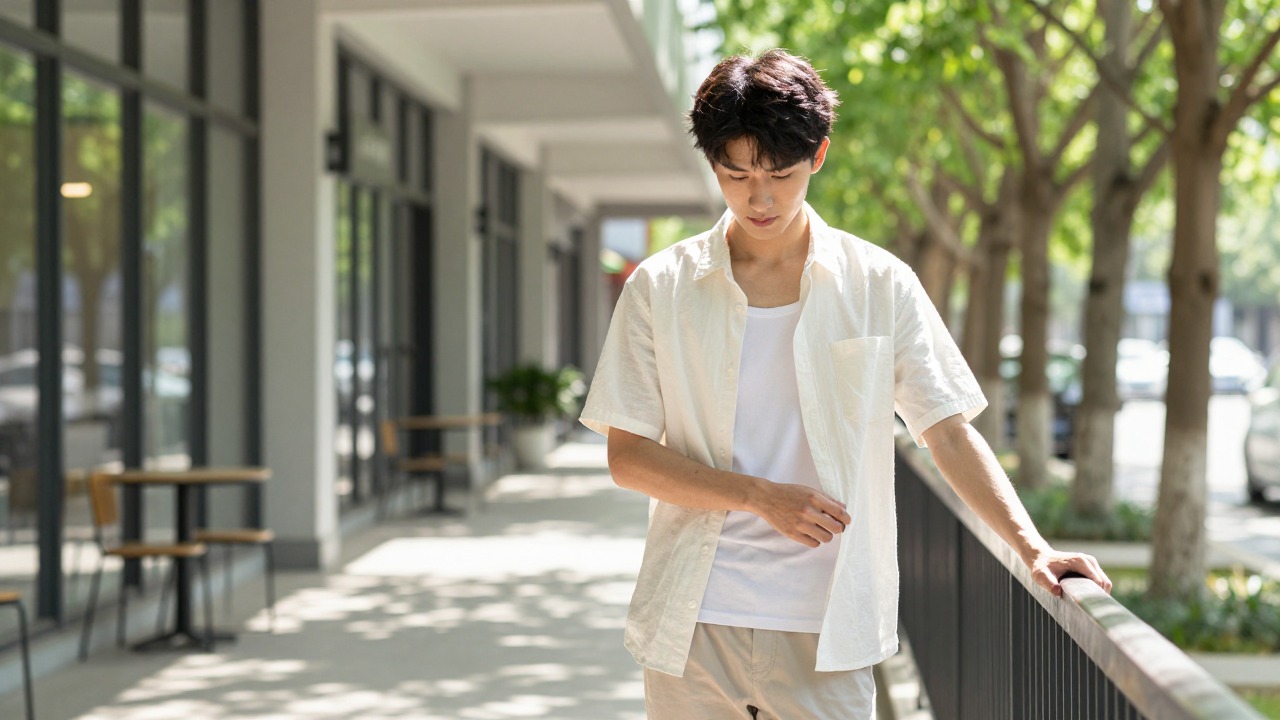
1. Why non-sheer base-layer tees are back at the center right now
Start with the content side. Chinese youth menswear is increasingly hostile to outfits that only work in photos but fall apart in real life. Especially in college-boy dressing, cleanfit, light Korean casual, and light commuter styling, the surface message may be “lightness” and “restraint,” but the real demand underneath is for much better control. White shirts should feel clean without looking too sheer. Pale open shirts should feel easy without looking empty. Thin tops should feel cool without collapsing into sweatiness and cheapness. The outer layer has not changed that much, but the problem has clearly moved to what sits underneath.
Then look at the product side. Chinese e-commerce naming around this category is now unusually direct: these products are no longer being sold as just “men’s short-sleeve tees.” They are being sold as solutions for white-shirt layering. Listing titles increasingly foreground words like non-sheer, invisible, skin-tone base layer, milk-grey layer, thin but not weak, bare-feel, cooling, basic inner layer, commuter use, and summer undershirt. That tells you the platforms understand the category differently now. What people are buying is not just another tee. They are buying a lower layer that manages transparency, thermal load, and upper-body order.
There is also a broader styling reason behind this. Chinese men’s style over the last two years has increasingly valued “light layering.” People still want shirts, thin overshirts, half-zipped knits, and lightweight nylon layers on top, but they do not want to genuinely dress in a heavy layered way. A normal white tee often feels too complete in these situations: it has its own neckline, its own thickness, and too much visual presence. Inside a light shirt, it can make the neck and chest zone feel crowded. A non-sheer base-layer tee works more like a calibrated support layer. Its job is not to appear. Its job is to let the outer layer read more cleanly.
Chinese-internet signals behind this topic
2. What non-sheer base-layer tees actually solve
The first problem is sheerness. This is the common problem behind almost every pale shirt and lightweight summer top. Many men genuinely like white shirts, off-white short sleeves, pale grey tees, and light-blue open shirts, but end up wearing them less because they are too transparent once worn in sunlight or movement. A non-sheer base-layer tee acts like a quieter buffer between the body and the outer layer. It does not need to be seen. It just needs to keep the outer layer dignified.
The second problem is heat. A lot of people know they need something underneath, but they hate the thermal and visual burden of a normal white tee. Especially under shirts, a full tee can make the neck feel crowded, the chest feel thick, and the whole upper body feel stuffed. Better non-sheer base-layer tees reduce that “I clearly wore another whole shirt underneath” effect. They are lighter than a normal tee, but more complete than a tank, and safer than wearing nothing.
The third problem is disorder. This is something people do not always describe directly, but it matters a lot. Summer outfits have fewer pieces, so once the upper body loses lower structure, the whole thing can start feeling loose, empty, or unconsidered. A white shirt with nothing inside can feel too exposed. A thick white tee under it can feel too full. A good non-sheer base-layer tee often resolves the exact zones that most easily go wrong — neckline, chest, underarm, sweat visibility, transparency — without turning the outfit into autumn layering.
3. Why they can fit college-boy, cleanfit, and light commuter dressing better than normal white tees in some situations
Normal white tees are not going away. But they are not the answer to every summer problem. In the youth-menswear directions currently strongest across Chinese internet culture — college-boy, cleanfit, and light commuter dressing — the weaknesses of a normal white tee become more obvious. College-boy dressing wants ease and youthfulness. Cleanfit wants low-noise order. Light commuter dressing wants polish without maturity overload. A standard white tee can become too visible in all three cases: the neckline is often too assertive, the sleeves pile inside shirts, and the thickness can flatten the lightness that summer outer layers are trying to create.
Non-sheer base-layer tees work especially well with the kinds of outer layers BoyStyle has already been tracking: open-collar short-sleeve shirts, textured short-sleeve shirts, sun shirts, lightweight nylon layers, thin knit polos, and half-zipped knit tops. What these pieces have in common is that they are already visually light. They do not want an entire full-bodied white tee fighting them underneath. The value of a non-sheer base-layer tee is that it stays much quieter.
On a practical level, they are also easier to integrate than many “cool-touch functional tops.” You do not need to rebuild your whole wardrobe around them. You do not need to push yourself into a visibly technical style. If you already wear white shirts, pale shirts, thin knits, jeans, straight trousers, shorts, and clean sneakers, they can slide straight into the rotation — and usually get used more often than expected.
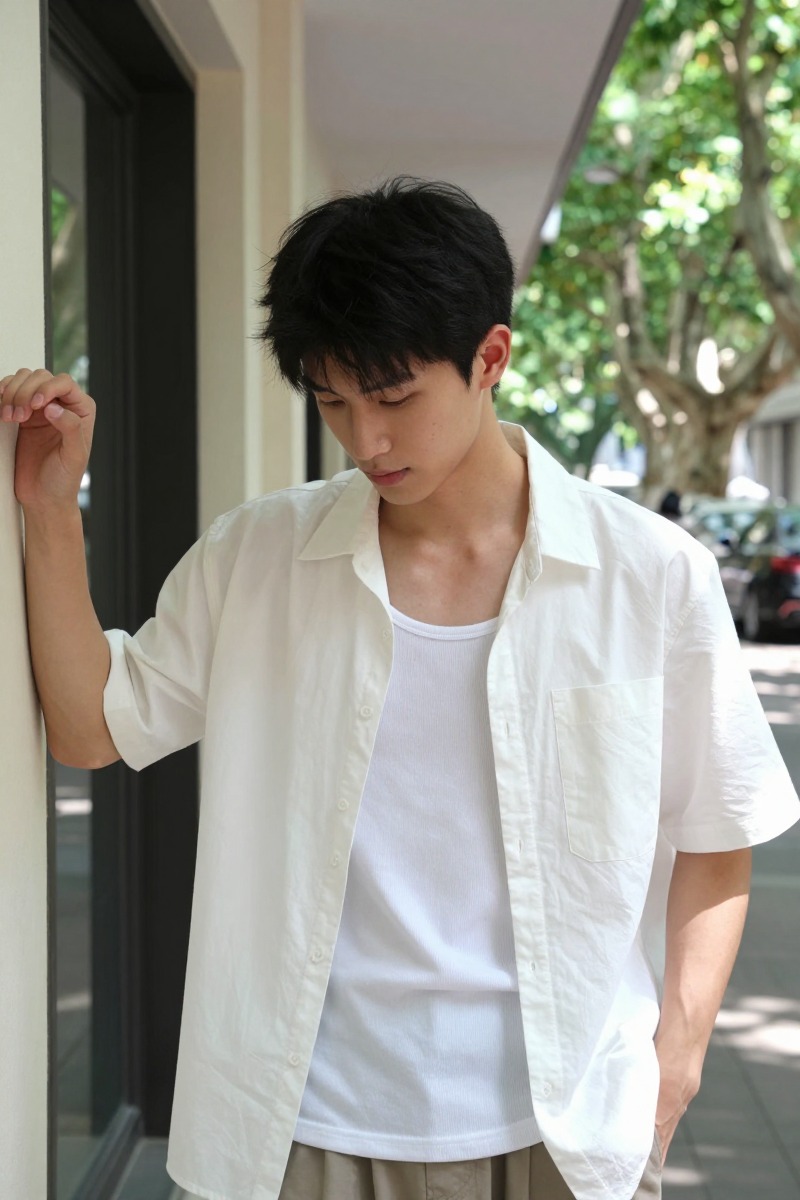
4. The four directions most worth checking first
1. Skin-tone / milk-grey invisible base tees
This is one of the most useful directions in current Chinese e-commerce. Many people assume a white shirt must always be paired with a white tee underneath, but in practice that often creates a visible inner boundary. A lower-contrast inner layer — skin-tone, milk-grey, pale grey-beige — disappears more easily under pale outer layers while still handling transparency.
2. Bare-feel seamless lightweight inner tees
This direction is more problem-solving than style-signaling. These products often stress seamless construction, lightness, cooling, and low visibility. Their strength is that they interfere very little with a white shirt, thin knit, or pale commuter shirt. Their risk is that if the fabric is too shiny, too slippery, or too much like functional underwear, they can look cheap fast. They require careful judgment of product photos and fabric description.
3. Lightweight crew-neck base tees
If you are not chasing total invisibility and simply want a lighter, smoother, less stuffy base layer, then a lightweight crew-neck inner tee is one of the easiest real-life choices. The key is that the neckline cannot be too high, the sleeves cannot be too long, and the chest cannot balloon. These work especially well in believable college-boy daily contexts — libraries, classrooms, malls, and casual commuting.
4. Cool-touch functional base-layer tees
If your route leans more toward light movement, city walking, frequent indoor-outdoor switching, or commuter practicality, cool-touch functional base-layer tees are also worth checking. But the goal is not to let them drift into sports compression-innerwear territory. The better versions keep logos, reflectivity, and compression feel under control so they still read like youth-menswear basics.
The four strongest buying directions
5. Ten checks before buying one
1. Do not assume white under a white shirt is always correct
This is where many people go wrong. If the white inner tee is too white, too thick, or too high at the neck, it becomes clearly visible under the shirt. Lower-contrast colours often work better.
2. The neckline should be more restrained than a normal white tee
A base-layer tee fails quickly if the neckline is too high or too thick. That creates a visible hard border around the neck under the outer layer. Better summer versions sit cleanly near the collarbone without bulk.
3. The fabric should stay low-shine
As soon as the surface starts reflecting too much light, the piece can stop reading as a refined base layer and start reading as cheap functional underwear.
4. Thin does not automatically mean safe
Many listings use words like ultra-thin or air-light as selling points, but for most men’s daily use, too thin can become more transparent, more clingy, and less dignified. The real target is light but not weak.
5. Sleeves should not be too long or too full
If the sleeves behave like a normal full tee, they will pile up inside shirts. Better base-layer versions usually keep the sleeve line more controlled.
6. Product pages should include pale outer-layer styling
If a seller is claiming white-shirt or pale-shirt layering value but never actually shows the product under a white shirt, pale short sleeve, or thin overshirt, that is a weak signal.
7. Avoid listings that depend entirely on muscles and dramatic lighting
If the whole page relies on chest emphasis, wet skin, and exaggerated body presentation, it is usually selling fantasy more than useful daily layering.
8. More colours are not always better
The best high-frequency colours for this category are usually very limited: skin-tone, milk-grey, pale grey, white, off-white, and muted grey-blue. Loud colours defeat the purpose.
9. Do not confuse “seamless” with “the tighter the better”
Seamless should reduce edge visibility, not turn the whole garment into a compression layer. If it clings too much, it starts looking more like underwear and loses dignity once sweat appears.
10. It must connect to your real wardrobe
A base layer worth buying must work with your actual white shirts, pale short sleeves, thin knits, jeans, straight trousers, shorts, and clean shoes. It is not a standalone tech item. It is summer infrastructure.
6. Six low-risk ways to wear it
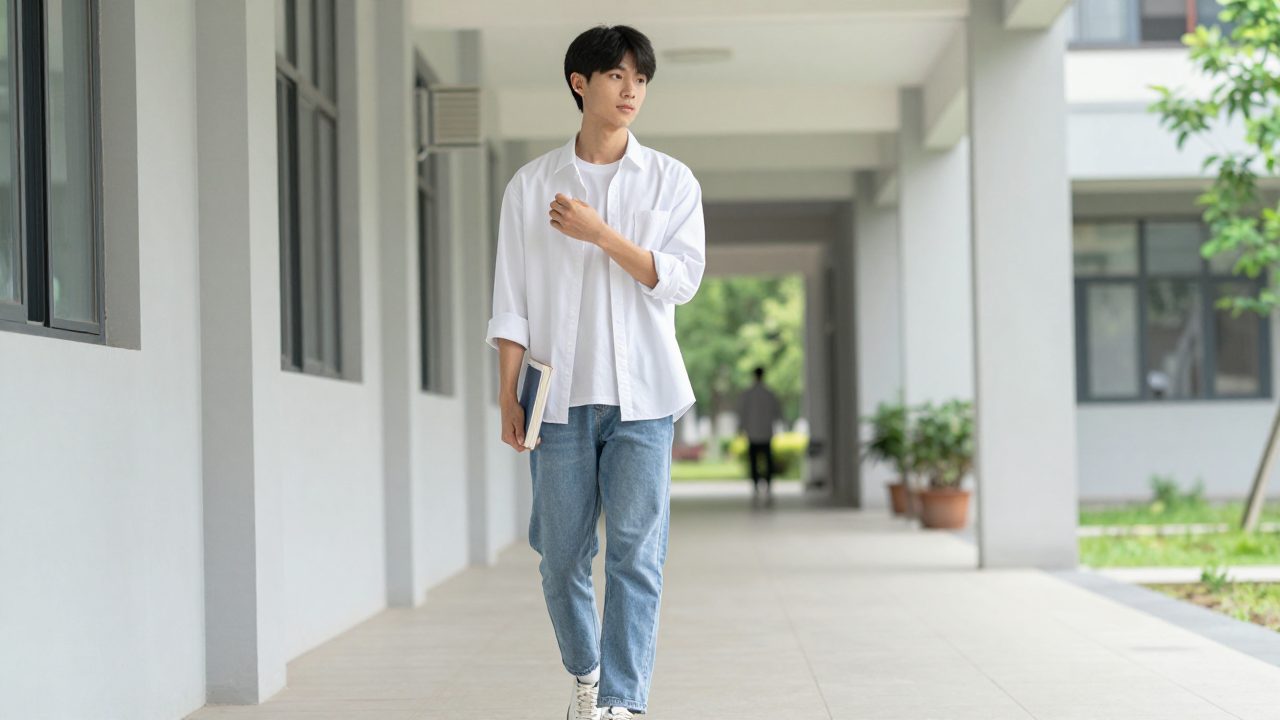
- Milk-grey non-sheer base tee + open white shirt + light-wash jeans: a classic summer college-boy formula, much steadier than wearing a white shirt bare and lighter than forcing in a thick white tee.
- Skin-tone invisible base tee + off-white open shirt + khaki straight trousers: ideal for low-noise cleanfit dressing and daily spaces like libraries, cafés, and malls.
- Cool lightweight base tee + light nylon sun shirt + nylon shorts: best for men who move a lot, sweat faster, and switch often between indoors and outdoors.
- Pale grey base tee + thin knit polo + tailored shorts: keeps the upper body flatter and cleaner without crushing the knit polo’s lightness.
- Bare-feel invisible layer + pale blue striped shirt + white trousers: especially useful for anyone who wants to wear pale colours but hates transparency accidents.
- Lightweight crew-neck base tee + textured short-sleeve shirt + relaxed shorts: excellent for summer evenings, malls, and city walking, keeping the outfit complete without making it heavy.
The shared logic across all of these is simple: the non-sheer base-layer tee is not there to be noticed as a premium inner piece. It is there to let the whole outfit’s lightness and order feel natural.
7. The Chinese shopping searches most worth checking first
Shopping / search entry points
These entry points matter not because they should trigger instant purchases, but because they quickly reveal how Chinese e-commerce is shaping the category right now. The products most worth continuing with usually share a few things: they show actual white-shirt or pale-shirt layering, the model photography feels natural, the neckline is controlled, the fabric stays low-shine, the page does not depend only on chest-focused body imagery, colour choices stay restrained, and even when the listing uses words like cooling, bare-feel, or seamless, the garment still looks like youth-menswear infrastructure rather than disposable functional underwear.
8. BoyStyle’s read on this non-sheer base-layer tee wave
The most interesting thing about this 2026 Chinese-internet wave is not that non-sheer base-layer tees have become a hot keyword. It is that they have recovered a very stable wardrobe position. They are not simply replacements for normal white tees, and they are not here to drag people into extreme technical dressing or body-display styling. What they really do is reorganize the unstable buffer zone between the outer layer and the body.
If you only want to add one basics layer that improves summer upper-body efficiency, stabilizes white shirts and pale tops, and makes the whole outfit feel cleaner without adding much burden, then yes — a non-sheer base-layer tee deserves to be high on the list. But only if it is the right kind: a colour that can visually step back, a neckline that does not push forward, fabric that does not shine, enough lightness without emptiness, and a form that can enter a real wardrobe instead of only looking good on a product page. Its value has never been about looking fancy. Its value is that it keeps you more stable inside the most ordinary but important scenes of Chinese youth-style life: class, commuting, bags on shoulders, malls, air-conditioned spaces, and summer evenings out.
Continue with: Why open-collar short-sleeve shirts are back at the center of men’s summer dressing, Why cool-touch tees are taking over the late-spring basics layer, Why sun shirts became a key cleanfit summer layer, and A summer cleanfit shop radar.
Reference pattern: recent Chinese-platform discussion around what men should wear under white shirts, how pale summer tops avoid transparency, invisible base-layer short sleeves, cool lightweight inner tees, commuter summer undershirts, and college-boy cleanfit foundation layers; Taobao and Tmall search entries such as “men white shirt undershirt non-sheer short sleeve,” “men non-sheer base tee summer cool-touch,” “men invisible base tee short sleeve skin tone,” and “men milk-grey undershirt tee shirt layer”; plus Bilibili-, Weibo-, and Xiaohongshu-style discussion around anti-sheer layering, low-visibility inner tees, pale-shirt styling, and summer upper-body no-mistake-buying logic.