How men’s trousers changed over time: from flares, slim cuts, and skinnies to wide legs, and how fit and fabric rewrote the body
If there is one place where menswear reveals changing taste most honestly, it is trousers. Trousers do not shout like outerwear and do not spike like footwear. What they do is change the whole body. Whether the figure feels long, light, young, rigid, old, compressed, or free often depends on trouser shape.
That means trouser history is not just about which cut became trendy. It is about a deeper question: what kind of male body did each period want to build? From flares to slim cuts, skinnies, tapers, wide legs, straight trousers, denim looseness, and lighter technical fabrics, the story is really a story about changing body proportion and changing ideas of youth.
1. Flares: the beginning of lower-body drama
Flares mattered because they proved that men’s lower-body silhouette could be dramatic. Trousers no longer had to simply fall downward. They could shape attention, rhythm, and attitude. Whether through 1970s rock references or later fashion revivals, flares introduced the idea that the trouser hem could actively perform.
Even if most young readers will not wear full flares every day now, the legacy remains: the hem no longer has to stay quiet.
2. Slim and skinny trousers: once “sharp,” later “dated”
Slim trousers and skinnies became dominant for good reasons. They sharpened the leg, looked neat, and connected well to certain phases of Korean styling, sneaker culture, tailored casualwear, and more body-defined menswear. But they also pushed the body into a very specific tightness.
Once youth menswear began shifting toward looseness, daily realism, movement, and more air around the body, skinnies started to feel old, hard, and too effortful. That does not mean they became impossible. It simply means they stopped being the main youth proportion.
3. Tapered trousers were a transition phase
Tapered trousers mattered because they helped many readers leave the skinny era without jumping immediately into wide trousers. They still held some order and control, but they no longer trapped the whole leg. That made them an important bridge fit.
Today, though, tapering feels more like a safe middle than a fresh main direction. It is not necessarily wrong. It just no longer defines the most current youth silhouette.
4. Wide legs and relaxed straight trousers reopened air around the body
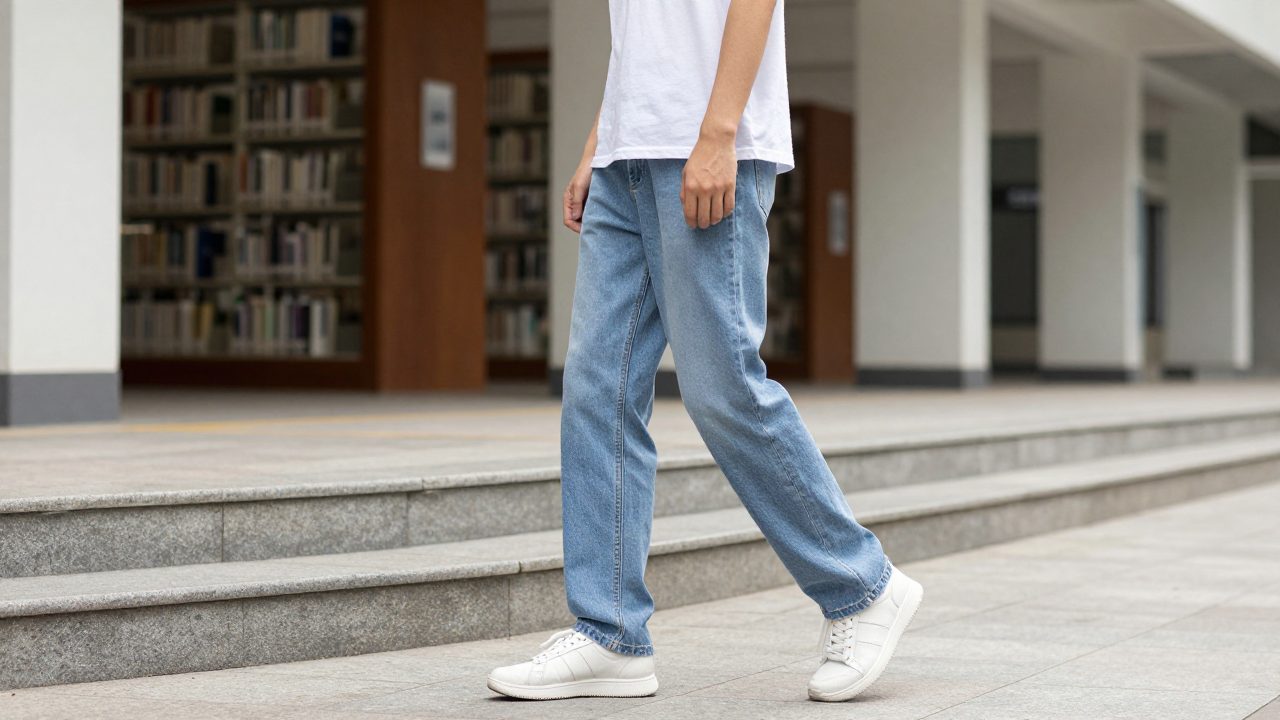
The return of wide and relaxed straight trousers came from a deeper change in body aesthetics. Youth menswear no longer wanted every leg traced tightly. It wanted space — enough room for trousers and body to exist together. Once that space appears, the whole figure changes. It becomes lighter, looser, younger, and more believable inside daily life.
That does not mean every wide trouser works. The best ones still need clean fall, stable drape, and a controlled relationship with the shoe. But the larger shift is clear: the lower body is no longer expected to stay compressed.
5. Fabric changed with fit
Trouser shape never changes alone. Fabric keeps pushing it. Slim and skinny phases often relied on elastic, body-following, more controlling materials. The newer loose denim, lighter nylon trousers, relaxed technical pants, and straighter wool-blend trousers depend on drape, movement, and surface response instead.
That is why fabric is not an accessory detail. It is part of the silhouette itself. Denim became more interesting again once it stopped trying to behave like rigid slim denim. Nylon trousers rose because they naturally support motion and lighter outdoor-coded dressing.
6. From “copying the body” to “organising the body”
Older trouser logic often tried to draw the leg very directly. The newer trouser logic is more about organising the body rather than tracing it. The difference is important. One asks what the leg literally looks like. The other asks what the body and trouser look like together.
That is why “flow” matters more now than “tightness.” Flow connects shoe, sock, upper-body silhouette, and movement. Tightness often isolates one body part.
7. The trouser directions most worth keeping now
- relaxed straight trousers: the most stable across youth menswear systems
- light-wash relaxed jeans: strongest for college-boy, spring-summer, and cleaner campus styling
- dark straight trousers or jeans: cleaner, calmer, and better for cooler seasons
- light nylon or technical trousers: strongest for city-outdoor and younger functional dressing
- well-controlled wide legs: strongest when the outfit can support stronger silhouette logic
8. The common misunderstanding: thinking “wider” automatically means “better”
Wider trousers are central now, but not every loose trouser works. If the fabric is poor, the break is too heavy, the drape is wrong, or the hem overwhelms the shoe, the result can feel like excess cloth rather than a silhouette. The strongest wide trousers still know where to release, where to fall, and where to stop.
9. Why trousers expose an era so clearly
Because trousers sit too close to the body and too close to walking. They reveal whether the leg is locked, whether the hem moves, whether the shoe is crushed, whether the knee has air, and where the outfit’s centre of gravity sits. That makes trousers one of menswear’s most honest historical records.
To revisit flares, skinnies, slim cuts, straight trousers, wide legs, and new technical fabrics is not just to revisit trends. It is to revisit the different ways menswear has repeatedly reimagined the young male body.
Continue with: why jeans never really left youth menswear, why straight trousers still matter so much in cleanfit dressing, and how workwear is growing a younger branch again