Workwear is growing a younger branch again: how coveralls, short coveralls, and overalls are moving back into youth menswear
Workwear in menswear is never entirely new, but the version returning now is no longer the same heavy, pocket-stacked, rough-edged, purely labour-coded workwear that dominated some older cycles. In younger menswear culture and Chinese-internet imagery, workwear is being edited into something lighter, younger, more body-aware, and more willing to connect with campus life, light commute styling, everyday street movement, and even a little social-media image language.
That is why the most interesting directions now are not only generic cargo trousers. They are coveralls, short coveralls, overalls, lighter utility jackets, and more controlled cargo structures. All of these carry strong role and structure, but whether they work now depends less on “how many pockets” and more on how they connect to body, proportion, movement, scene, and current youth-menswear mood.
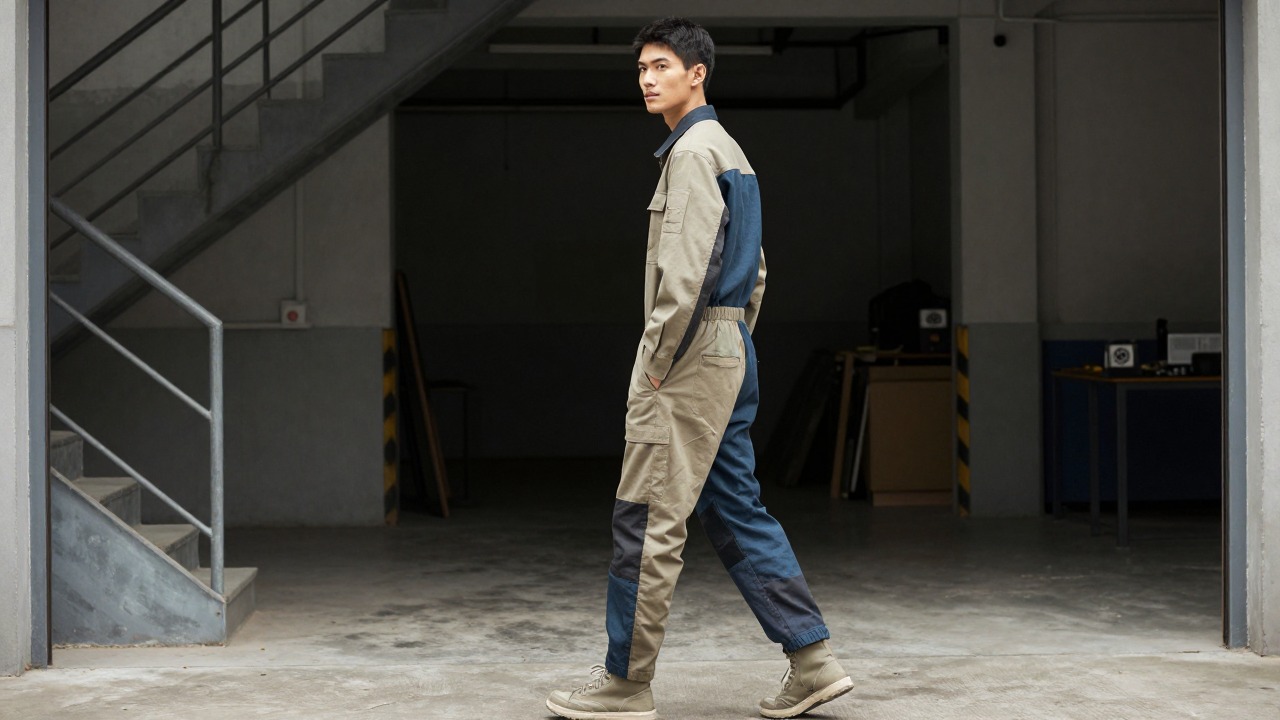
1. Why workwear came back, but differently this time
Earlier workwear waves often focused on heaviness, durability, visible wear, and obvious labour references. The younger version now is more edited: enough structure to keep the identity, but lighter in weight, cleaner in color, and less likely to crush the body underneath it.
In that sense, current youth workwear feels less like “dressing as a worker” and more like “using workwear language to build a younger silhouette.”
2. Coveralls are special because they build the whole silhouette at once
Coveralls are unlike an ordinary jacket or trouser because they already contain a full-body structure. You do not need to decide how upper and lower parts connect. That also means they are unforgiving. Shoulder line, waist relation, leg fall, upper-body volume, and fabric weight all decide whether the result feels sharp or theatrical.
For youth menswear, the strongest coveralls are rarely the heaviest or most literal old industrial versions. They tend to be slightly lighter, cleaner, and more responsive to the body.
3. Short coveralls are one of the most overlooked but useful summer directions
Compared with long full-body coveralls, short coveralls often feel like the younger, lighter version of the same logic. They are easier for summer, easier for movement, and much easier to connect to city-life, holiday, or social-media imagery. If the proportion lands around the upper thigh to mid-thigh range correctly, they can create a very convincing younger workwear silhouette on East Asian bodies.
The key is not costume fantasy. It is whether the garment still lets the body look active, young, and believable.
4. Why overalls always survive
Overalls are risky because they can easily become too childish, too retro, or too costume-like. But they never disappear because suspender structure is simply very strong. It immediately changes shoulder reading, chest layering, waist rhythm, and lower-body proportion.
The overalls that work best now are usually less exaggerated: moderate denim or utility fabric, calmer colors, cleaner leg lines, and simple top pairings like white tees, striped tops, tanks, or lighter sweatshirts. The goal is not cuteness. It is silhouette.
5. The most common failure in workwear is not being too plain, but being too heavy
People often respond to workwear by adding more: more pockets, thicker fabric, larger boots, heavier bags, more utilitarian detail, more distressing. The result is often not stronger workwear but a more burdened body. For younger and slimmer East Asian bodies especially, excessive workwear weight can erase the person entirely.
The better route now is subtraction workwear: keep structure, reduce visual burden; keep identity, reduce overload; keep function, clean up the palette.
6. The best settings for these items
- coveralls: industrial passages, staircases, workshop-like architecture, editorial urban spaces
- short coveralls: summer streets, studios, light outdoor settings, weekend movement, lifestyle imagery
- overalls: campus, cafés, studios, younger creative spaces
- lighter work jackets and cargos: easiest for ordinary city dressing
These settings show that workwear is strongest not because it “looks like labour,” but because it makes sense with a body, a task, and a place.
7. The most dependable workwear formulas
- light work jacket + white tee + jeans: the easiest route into youth workwear
- coveralls + cleaner sneakers or boots: strongest when the silhouette itself holds
- short coveralls + mid socks + sneakers: ideal for summer and image-led youth styling
- overalls + white tee or tank: one of the clearest ways to let suspender structure and youthfulness work together
These formulas make one thing obvious: workwear’s real strength lies not in pocket count, but in how it restructures the body.
8. What workwear means in youth menswear now
It now works as a style resource that grows out of labour and function logic, but gets re-edited through youth, image culture, and lighter everyday life. It is no longer only the sign of rugged masculinity. It can now sit alongside youthfulness, city life, light technical dressing, editorial photography, and even a small amount of social-media performance.
That is why coveralls, short coveralls, and overalls are worth revisiting now. Not as retro costumes, but as evidence that workwear can still live on in a younger body.
Continue with: why outdoor sportswear is moving into the center of youth menswear, why Stone Island matters beyond ordinary workwear, and why jeans remain so hard to replace in youth menswear