Bag-charms shop radar 2026: why keychains, plush bag charms, climbing-cord clips, and low-saturation bag jewelry are taking over the detail layer of campus-boy and cleanfit bags
If you take apart the current Chinese-internet conversation around youth menswear, one shift becomes very clear: people are still looking at bags, caps, shoes, silver accessories, and trousers, but the detail layer is moving somewhere more specific. The question is no longer only “what bag should I carry?” It is increasingly “should there be something on the bag, what should hang from it, and how much is too much?” Xiaohongshu-style titles keep circling phrases like “bag charm recommendations,” “what can boys hang on their bags without looking childish,” “how to use plush charms without looking tacky,” “cleanfit bag charm,” and “campus bag decoration.” Commerce naming across Taobao-style marketplaces is also full of “keychain,” “bag charm,” “plush bag add-on,” “climbing-cord charm,” “acrylic tag,” “bag chain,” “low-saturation,” “campus,” and “commuter.” At the same time, short-video, Weibo, and Bilibili-style discussion increasingly treats charms as the explanation for why a bag suddenly looks lived-in, personal, and real.
That makes bag charms especially worth turning into a shop feature. On the surface, they look like a small accessories topic. Underneath, they answer a more advanced style question: once youth bags have already moved away from giant logos and loud trend branding, what gives them life, use-traces, and personal atmosphere? For campus-boy dressing, cleanfit, light Korean casual, Japanese light leisure, and softer student-coded wardrobes, the answer is increasingly not “buy a more expensive bag.” It is “add the right detail layer.” That might mean a low-information charm, a small plush add-on that matches the outfit mood, a restrained climbing-cord attachment, or a bag chain that adds texture without dragging the whole look into noise or childishness.
That is why bag charms matter right now. Their real value is not cuteness by itself, and not design by itself. The value is whether they can add a little use-memory, a little emotional texture, and a little recognizability to the bag. Used well, they turn a tote bag, nylon crossbody, backpack, or commuter bag from “a product-page bag” into “a bag that actually belongs to this person.” Used badly, they instantly drag cleanfit toward childishness, make campus dressing look cheap, or turn a calm daily look into visual clutter. In other words, bag charms are not selling decoration alone. They are selling bag completion, style credibility, and the lived-in realism Chinese-platform youth fashion currently loves.

1. Why bag charms have become a real buying signal in Chinese youth menswear
Once current Chinese-platform signals are grouped together, there are at least five reasons behind this rise.
- First, the bags themselves have become quieter. Current campus-boy, cleanfit, light commuter, and light Japanese casual bag choices are clearly moving toward basic colors, lower logos, lighter materials, and believable daily use. Once the bag body gets quieter, people naturally start asking how to make the same basic bag feel more personal.
- Second, Chinese-platform style culture values lived-in realism. The most approved bags are not always the most expensive or most hyped. They are often the ones that look like they actually go to class, onto the subway, into cafés, libraries, convenience stores, and short daily trips. Bag charms add exactly that use-trace layer.
- Third, youth accessories are moving from piling on to controlled detail. Instead of stacking everything loudly, the stronger current direction is calm main items plus one or two quieter detail points. Bag charms fit that logic perfectly.
- Fourth, platform supply is now mature enough. Commerce pages have already split charms into stable routes: plush add-ons, metal keychains, climbing-cord mini accessories, acrylic tags, bag chains, Y2K micro-details, campus novelty charms, and small IP toy hangers. That means the category has moved beyond random photo props.
- Fifth, charms suit current youth menswear language. They are lighter than giant graphics, less aggressive than heavy street accessories, more human than purely functional clips, and more memorable than a completely blank bag.
So this rise is not really about hanging more things. It is about Chinese youth menswear reaching a more detailed stage. Once clothes, trousers, shoes, and bags all become calmer, style difference naturally moves into smaller zones. The charm becomes the emotional expression layer of the bag.
Chinese-platform signal patterns behind this topic
2. The four kinds of charm shops most worth browsing first
As with caps and belts, the smartest way to shop bag charms is not to memorize store names first. It is to understand what kind of shop actually suits your wardrobe. Different stores are not selling the same “charm.” Some sell campus softness and small playfulness. Some sell cleanfit-friendly low-presence details. Some sell light-functional cord language. Others sell quiet tote-bag and commuter-bag decoration layers. For BoyStyle readers, choosing the right shop type matters more than chasing a single viral charm.
1. Low-saturation campus-fun charm shops: best for backpacks, tote bags, and daily school bags
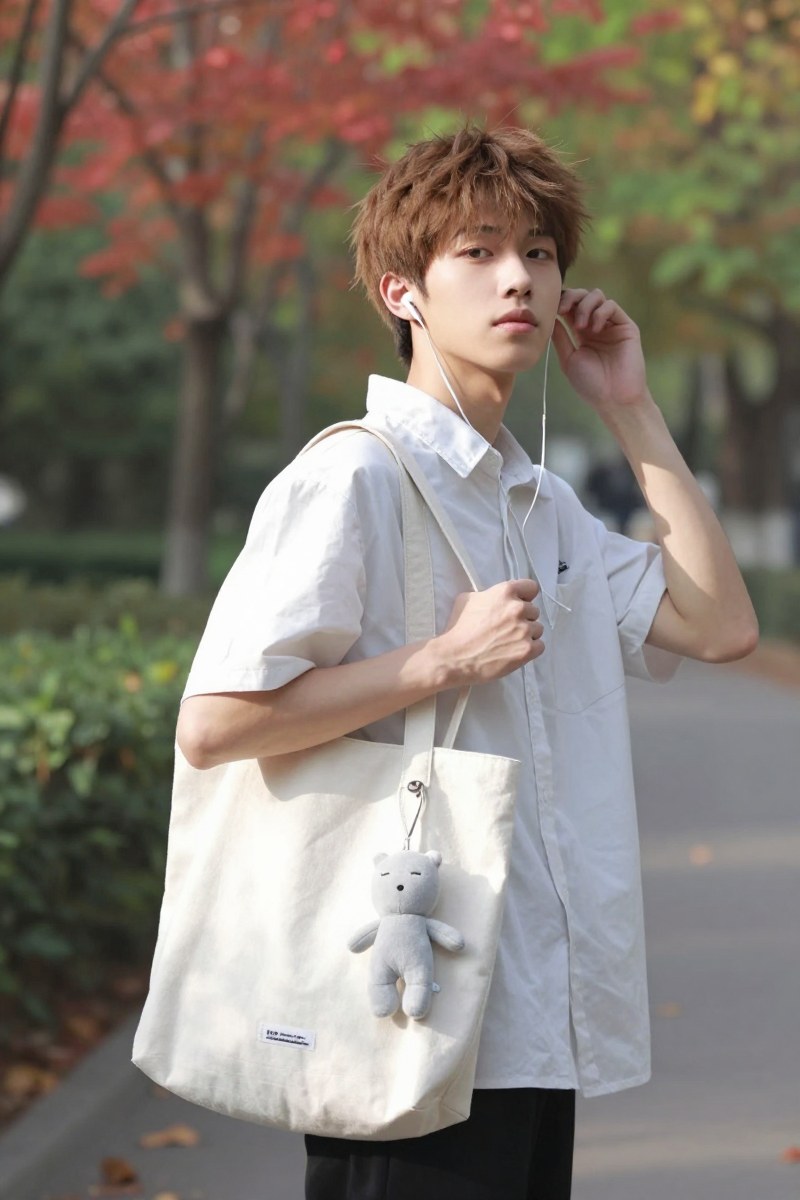
If I had to recommend one direction with the lowest failure rate, it would be low-saturation campus-fun charm shops. These usually sell small, not-too-bright, emotionally light pieces: muted plush charms, textile mini dolls, softened animal add-ons, small plush keychains, woven-tab hangers, campus-coded letter tags, and hand-feel fabric accessories. They work especially well with canvas totes, school backpacks, everyday double-strap bags, and student-coded shoulder bags.
The reason these shops matter is not only that they are cute. They understand the current Chinese-platform preference for something that feels a little playful and a little human, but never too childish. The better products in this lane usually share several traits:
- the color stays muted;
- the size stays controlled;
- the material leans soft rather than plastic;
- the information level stays light.
This route is especially good for classic campus combinations: white tees, striped shirts, pale denim, athletic shorts, canvas shoes, German trainers, backpacks, and tote bags. Done well, the charm makes the bag feel like a real daily object. Done badly, it falls straight into cheap campus-gift territory.
2. Low-presence metal keychain shops: best for cleanfit, light commuting, and more mature detail control
If your wardrobe leans more toward cleanfit, light commuting, short-sleeve shirts, knit polos, straight trousers, nylon bags, and quieter accessories, the second lane worth focusing on is the low-presence metal keychain shop. These stores are not selling loud car-key add-ons or heavy industrial hooks. They sell lighter small metal pieces that can live on a bag: restrained key rings, short-chain keychains, low-reflection metal tags, slim bag jewelry, matte clips, and low-profile letter hardware.
The value of this lane is that it brings order rather than noise. Many cleanfit readers do not want plush charms, but they also do not want a completely empty bag. A small metal hanger often becomes the safest answer: a little shine, a little line, a little use-trace, but nothing that drags the bag toward childishness or aggressive streetwear.
To judge whether these stores are worth following, the key is not only what metal they claim to use. It is whether they handle the details properly:
- the finish should not be too reflective;
- the chain should stay slim;
- the object should not look like a pure hardware-tool sample.
These details work especially well on nylon crossbodies, commuter bags, understated backpacks, and calm tote bags. They are even more useful if the wearer already uses low-contrast silver accessories, belts, or glasses, because they help the whole visual language feel unified.
3. Climbing-cord and light-functional charm shops: best for nylon bags, light gorpcore, and city-outdoor routes
The third category worth serious attention is the climbing-cord and light-functional mini-accessory shop. This lane has been stable on Chinese platforms because it overlaps perfectly with light gorpcore, light technical dressing, city outdoor, commuter nylon bags, and bag-detail functionality. These stores are not really selling large tools. They sell daily miniatures: climbing-cord charm knots, woven loops, mini clips, small lightweight buckles, reflective-cord accents, short fabric hangers, and compact utility rings.
The biggest danger here is obvious: a lot of these things are really functional parts before they are style accessories. To work as bag details, they need to become smaller, softer, quieter, and more everyday. The good versions do not shout “I go camping.” They just add one light layer of structure and use-feel. For nylon crossbodies, light sports bags, and grey-black backpacks, they often feel more natural than plush toys and more relaxed than metal chains.
When browsing this lane, the best filters are simple:
- keep the cord color basic;
- keep the accessory small;
- keep the hardware low-contrast;
- keep the hanging length short.
If you already wear sun shirts, nylon shorts, straight trousers, runners, German trainers, or lightweight baseball caps, this category becomes especially useful because it sells functional realism without over-performing function.
4. Acrylic and small-graphic charm shops: best for readers who want a little personality without going plush
The fourth category that keeps showing up is the small acrylic tag and micro-graphic charm shop. This route is useful for readers who do not want plush, do not want heavy metal language, but still want one personal note on the bag. These stores often sell acrylic mini tags, transparent color plates, small visual tags, little graphic signs, line-illustration pieces, and miniature cartoon or icon tags.
The problem is obvious: acrylic very easily becomes cheap. The better acrylic charm stores usually satisfy a few conditions:
- the graphic stays simple;
- the object stays small;
- the edges and hardware feel clean;
- the palette stays restrained.
This lane fits basic-color totes, black-grey school bags, simple canvas bags, and cleaner backpacks. The goal is not to turn the bag into a fandom display board. The goal is just to add one small memory point.

3. The six charm directions most worth adding to the cart
Product directions and shopping routes
4. The ten judgment points that stop bag-charms from going wrong
1. The scale is too large
Many charms fail not because they are badly designed, but because the ratio is wrong. A charm that takes over too much of the bag will unbalance the whole object immediately.
2. The color is too loud
High-saturation neon, bright pink, pure red, and candy tones often drag cleanfit and campus dressing toward messy novelty.
3. The material looks cheap
Hard plastic surfaces, weak hardware, shedding plush, and blurry print quality all turn a “life-detail” charm into giveaway-level clutter.
4. The information level is too full
If a charm has graphics, words, shine, bells, chains, cords, and extra pieces all at once, the bag becomes noisy very quickly.
5. The hanging cord is too long
Too much length creates visual mess and moving clutter. The best charms usually stay closer to the bag and hang short.
6. The hardware is too shiny
For cleanfit and light commuting, mirror silver and bright gold are often too much. Gunmetal, matte silver, black plastic, and low-reflection parts are safer.
7. You only judge flat lays, not actual bag styling
Bag charms are highly context-dependent. Cute in flat photography does not guarantee wearable on a real bag.
8. You ignore the material of the bag itself
Plush works better with canvas and campus bags, metal works better with nylon and commuter bags, and cord details work better with light-functional bags.
9. You expect one charm to save the whole look
Charms add completion. They do not replace the work of the outfit itself.
10. You confuse “fun” with “more”
The current Chinese-platform sweet spot is usually one memory point, not a full charm cluster. Control looks more believable than overload.
5. How each styling route should choose bag charms
- Campus-boy route: for canvas bags, school bags, and backpacks, go first toward small plush charms, textile pieces, and low-saturation woven tags.
- Cleanfit route: for nylon crossbodies, commuter bags, and basic-color totes, the safest choices are minimal metal keychains, slim bag chains, and low-contrast letter tags.
- Softboy route: softer plush, fabric charms, and small toy-style add-ons can work well, but the size still needs to stay restrained.
- Light gorpcore or light-functional route: climbing-cord charms, mini loops, and short cord pieces are usually the best fit, as long as they do not turn the bag into a gear rack.
- Light commuter route: small metal pieces and short chains are the most reliable, with the occasional small low-contrast acrylic tag if the palette stays calm.
These routes look different on the surface, but the shared logic stays the same: the charm is not the protagonist. It is the use-feel layer that connects the bag, the outfit, and the person.
6. The shop signals most worth following
If you work backward from Chinese-platform commerce and style naming, the most useful charm shops usually share several traits:
- they show charms on real bags rather than only as flat products;
- they show the same charm on totes, nylon bags, backpacks, or school bags, which means they understand context;
- their color system stays stable rather than relying on high-saturation trend shades;
- they often sell related micro-accessories too, such as keychains, small chains, cord details, and bag decorations;
- their product titles repeatedly use words like low saturation, campus, commuter, simple, niche, light functional, bag charm, and bag decoration rather than only hype words.
These stores are not always the largest or hottest, but they are more likely to provide details that can actually stay in daily life. For BoyStyle readers, the long-term value is not a charm that is viral right now. It is a charm you can use this summer, keep using in autumn, carry over to your next bag, and still not find embarrassing later.
7. BoyStyle’s conclusion on this bag-charm buying signal
What looks like a simple “what should boys hang on their bags?” topic on Chinese platforms is actually answering a more developed youth-menswear question: once the bag itself is already quiet and basic enough, what makes it feel like a bag that really belongs to the person carrying it? That is why keychains, plush bag charms, climbing-cord mini accessories, low-saturation bag chains, and small acrylic tags are rising together. They matter not because they are dramatic, but because they have moved back into the most useful place inside youth daily dressing: adding use-memory, recognizability, and just enough emotional texture without throwing the whole look into chaos.
If you want to add one detail to a bag this summer that is hard to waste and easy to feel immediately, bag charms deserve to be near the top of the list. But not just any charm. The right one is small enough, calm enough, good enough in material, believable once it goes onto the bag, and compatible with the clothes and bag you already use. It may not change your look as dramatically as new shoes or a whole new bag, but it can make people feel something more important: that your bag is not there for a product shot. It is there because it actually belongs to you.
Read next: Why nylon crossbody bags are taking over the daily commute layer of campus-boy and cleanfit menswear, Cap shop radar 2026, Summer belt shop radar 2026, and Why washed baseball caps have returned to the center of cleanfit.
Chinese-platform source-pattern basis: this article mainly draws on publicly visible Chinese-platform search, content, and commerce naming patterns around bag charms, keychains, plush add-ons, climbing-cord mini accessories, acrylic tags, and bag jewelry, including recurring expressions such as “what should boys hang on their bags,” “bag charm recommendations,” “how to use plush charms without looking childish,” “campus bag keychain,” “cleanfit bag charm,” and “commuter bag decoration,” together with discussion patterns around making bags feel more lived-in and believable, plus commerce clusters built around bag charms, plush hangers, climbing-cord details, acrylic tags, bag chains, low saturation, campus use, commuter styling, and small niche accessories.