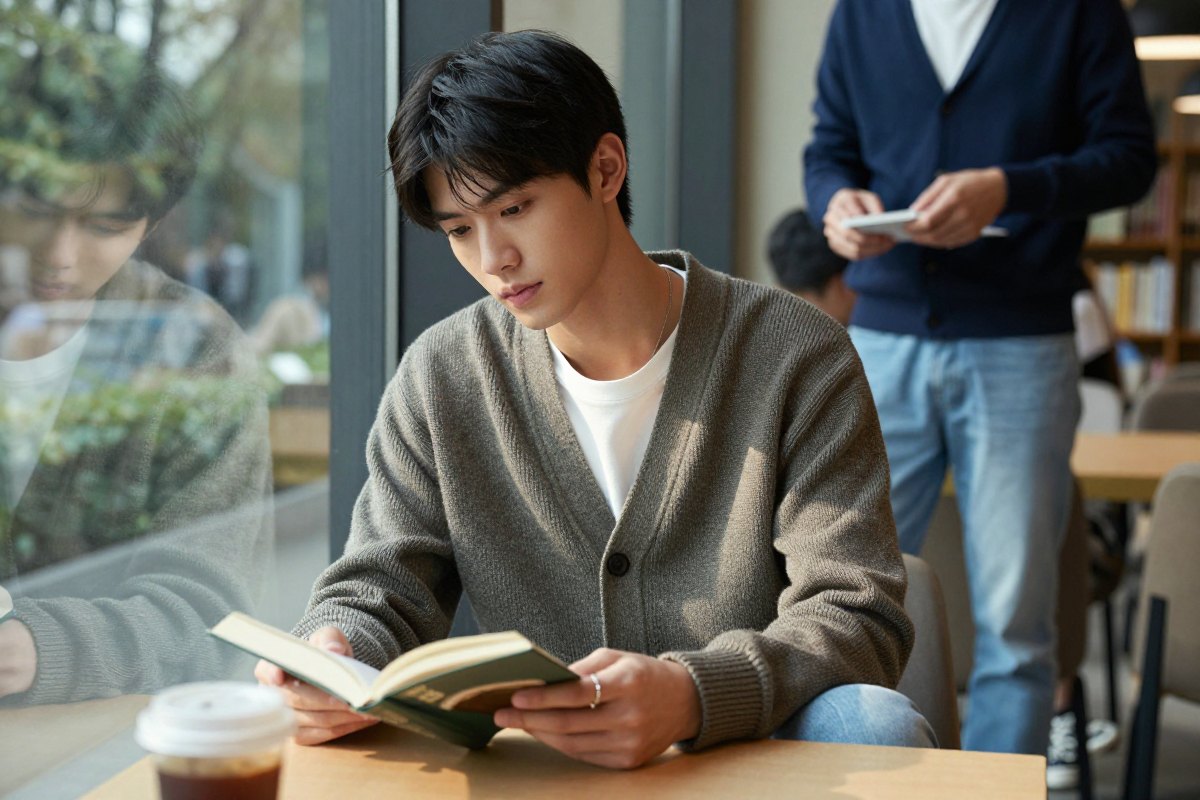
Why cardigans remain one of the most reliable tops in softboy and campus-boy wardrobes
If one had to choose a top that almost never feels out of place in youth-oriented menswear, the cardigan would be near the top of the list. It is less distant than tailoring and more shaped than a basic sweatshirt. That middle position is exactly why it works: it can soften a look, add a visible layer, and make an outfit feel more considered without becoming too formal or too loud.
This is why cardigans keep returning across softboy dressing, campus-boy wardrobes, cleanfit, Korean-inspired student looks, and lighter Japanese casual styling. It is not only a niche “aesthetic item.” It functions as an efficient middle layer: light enough for spring, autumn, and indoor air-conditioning; soft enough to create approachability; and practical enough to connect easily with shirts, white tees, tanks, straight trousers, washed denim, sneakers, and loafers.
1. Its real value is not only softness, but structure
Many people describe cardigans as soft, gentle, literary, or “creamy.” That is true, but not the full story. Their more practical value is that they create instant layering structure. A white tee and straight trousers can look fine on their own, but once a cardigan sits over that combination, the outfit usually feels more complete and visually intentional.
That matters a lot in youth menswear, where most everyday outfits are built from relatively simple pieces. The upper layer ends up deciding whether the look reads as random or curated. A cardigan rarely dominates the entire outfit, but it quietly shapes the upper body, softens the silhouette, and makes the wearer look more organized.
2. Why does it work so well for softboy and campus looks?
Because both of those style worlds depend on a visual mood that is light, neat, approachable, and not overly sharp. A cardigan compresses that mood into one relatively easy item. Knit texture already carries softness. Buttoning it creates order; wearing it open creates ease. It can move toward a more academic direction with a shirt, or a simpler campus direction with a white tee.
For campus-oriented wardrobes, it also has a practical advantage: it works across many normal settings. Classes, libraries, coffee runs, casual photos, low-pressure dates, and ordinary daytime movement all make sense in a cardigan. It does not demand a dressed-up environment, but it still looks more intentional than a plain hoodie or tee.
3. When buying one, check silhouette first, color second, details third
If you want a cardigan that stays useful for a long time, the first thing to evaluate is silhouette. For most young menswear wardrobes, the safest direction is slightly relaxed, with naturally dropped shoulders and a length that does not extend too far. Too tight and it starts feeling stiff or older than intended. Too long and too limp, and it loses the controlled shape that makes it helpful.
Second comes color. The most reliable ones are grey, oatmeal, cream, deep navy, charcoal, clean black, and lower-saturation brown tones. These colors connect easily with the rest of a wardrobe: white tees, light-blue shirts, grey sweatpants, dark denim, khaki trousers, black straight-leg pants. The harder choices are often the muddy yellowish or oddly dull shades that look atmospheric in photos but weak in daily wear.
Only after those two should you worry about neckline, button scale, placket width, pockets, or knit pattern. Those details influence whether the piece leans more academic, clean, Korean, or softboy, but they rarely matter more than silhouette and color.
4. Fabric decides whether it feels relaxed or just cheap
Cardigans are especially vulnerable to weak fabric because they are not strongly structured garments to begin with. If the knit is too thin, too limp, too shiny, or too quick to pill, the entire piece can look tired. Common problems include stretched necklines, twisted fronts, drooping hems, and sleeves that lose shape quickly.
A stronger choice usually has some thickness without becoming heavy, visible knit texture without shine, and enough body to hold its line on the torso. The point is not to chase luxury fiber language, but to choose a knit that still looks alive when worn.
5. Three stable cardigan formulas
- Cardigan + white tee + straight trousers: the cleanest and easiest formula, especially for readers who want a more polished version of basics.
- Cardigan + light shirt + denim: slightly more academic and campus-oriented, especially good in spring and autumn.
- Cardigan + tank or inner layer + relaxed casual pants: softer, lighter, and more aligned with a softboy or Korean casual mood.
These formulas work because the cardigan acts as a mediator. If the trousers feel too hard or formal, it relaxes them. If the inner layer feels too plain, it adds completion. It is less a star piece than a balancing layer.
6. The most common mistakes
The first is buying one too slim. Many people think knitwear should hug the body to look neat, but that often makes the shoulders, chest, and arms feel tense. The second is going oversized in a way that has no shape at all. The third is overcomplicating the color story. Cardigans already carry mood; if the tee, trousers, shoes, and bag all compete for attention, the outfit falls apart. The fourth is forgetting the shoes. A soft upper half and a clean lower half can still collapse if the footwear feels too heavy, too dirty, or too unrelated.
7. If your wardrobe is still small, where should you start?
If you can only buy one, a plain V-neck cardigan in grey, charcoal, navy, or a clean oatmeal tone is the safest place to begin. Slightly relaxed fit, medium weight, length around the hip, easy with both white tees and light shirts. That is the kind of piece that can move toward campus, softboy, or cleaner minimal styling without fighting the rest of the wardrobe.
The cardigan is not dramatic, and that is exactly why it lasts. For many young men trying to look more put together without dressing too hard, it is not a decorative extra. It is one of the cheapest ways to make everyday dressing feel more coherent.
Continue with: why college-boy style became such a stable entry point, basics, bottoms, and shop Source references: Xiaohongshu: men’s cardigans, Xiaohongshu: softboy cardigans, Xiaohongshu: campus-boy cardigans