Low-contrast inner layers are taking over the 2026 summer upper body: why milk-grey and skin-tone base-layer tanks are replacing pure white innerwear in more men’s wardrobes
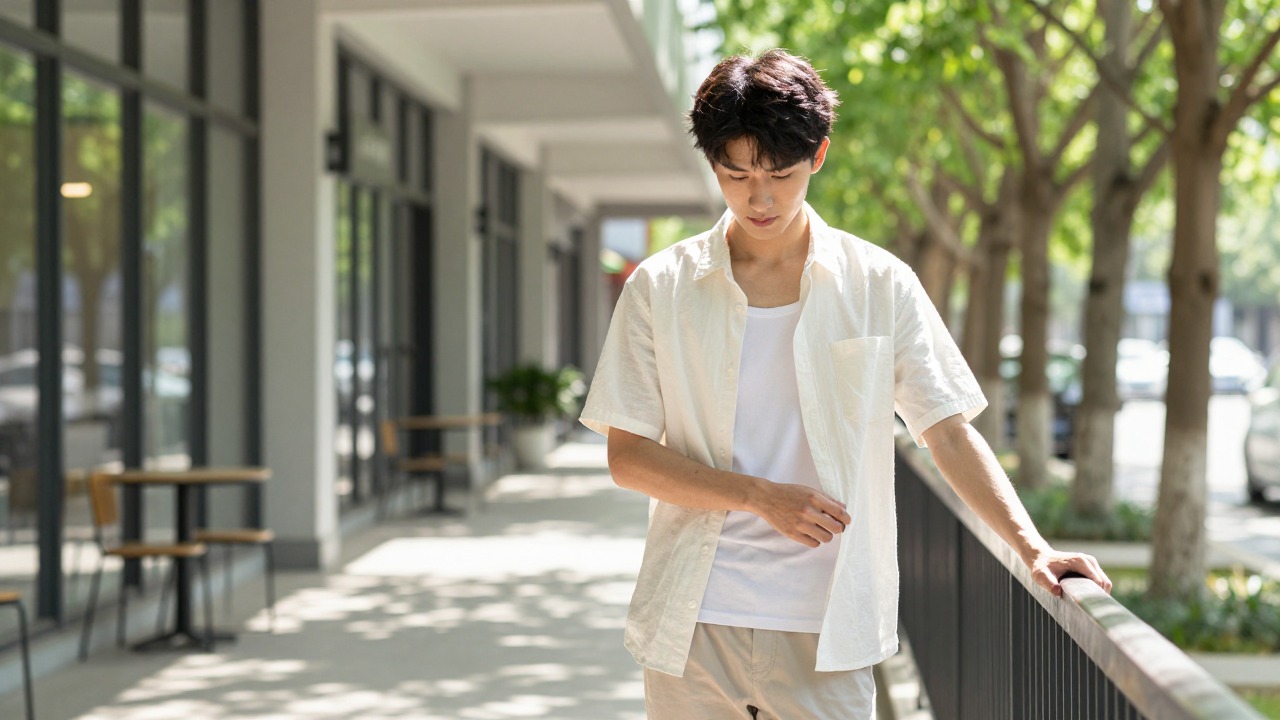
One of the strongest recent buying signals across Chinese menswear internet culture is easy to miss if you only look at the outer layer. People are still talking about white shirts, pale open-collar shirts, lightweight short sleeves, nylon sun shirts, and cleanfit summer tops — but they are no longer assuming that the default answer underneath has to be a pure white crewneck tee. More and more product naming, styling discussion, and no-mistake-buying advice now revolves around low-contrast inner layers, especially milk-grey, skin-tone, pale oatmeal, and soft beige-grey base-layer tanks or sleeveless inner tops. On Taobao and Tmall these show up through naming like “white-shirt inner layer,” “anti-sheer tank,” “invisible tank,” “nude-feel base layer,” “milk-grey innerwear,” and “skin-tone anti-show tank.” On Xiaohongshu-, Weibo-, and Bilibili-style discussion, the same shift shows up as questions like “what should men wear under a white shirt without looking awkward,” “stop stuffing pure white tees inside pale shirts,” and “how to stay not-sheer without looking heavy in summer.”
This is not just a small hack. It is a real buying trend. For the current youth-menswear reader, the question is no longer whether there should be an inner layer. The question is whether the inner layer makes the whole outfit cleaner, or whether it makes the whole outfit feel like an extra undershirt shoved in under a thin shirt. Pure white innerwear still exists, but its limits are more visible now: inside thin shirts it creates overly clear edges, inside pale open shirts it often fills the chest and neckline area too heavily, and once sweat enters the picture it can quickly look thicker and more obvious than intended. Low-contrast base-layer tanks, by contrast, answer what Chinese-internet youth menswear currently cares about most: freshness, visual calm, repeat wear, cleaner photos, and real-life ease.
This topic also fits BoyStyle’s editorial direction unusually well because it is not an abstract fashion idea. It is a practical product-judgment problem: which colors are worth buying, which fabrics are likely to fail, which product pages are misleading, which store routes fit college-boy and cleanfit dressing better, which base-layer tanks really work under white shirts and pale tops, and which ones only look convincing in livestream-style marketing. In youth menswear, the most useful difference often comes from precisely this kind of quiet category — a basics layer that is not dramatic, but clearly improves the efficiency and finish of the whole outfit.
1. Why low-contrast inner layers are getting stronger right now
Start with the Chinese-internet content mood. Summer menswear discussion is no longer satisfied with “recommend a white shirt” or “recommend an open-collar shirt” on its own. The next question comes immediately: what should go underneath so it does not show through, feel thick, look awkward, or make the whole outfit feel over-layered? That is why phrases like “what to wear under a white shirt,” “how men wear pale shirts without transparency,” “tank or tee under an open shirt,” and “how to choose low-presence summer inner layers” are showing up more often. Once that kind of question repeats often enough, e-commerce reacts fast. That is why Taobao and Tmall now cluster around naming like milk-grey, skin-tone, nude-feel, invisible, anti-sheer, shirt base layer, men’s summer, cleanfit, and campus daily use. Those are not decorative words. They show that platforms now understand this as a real upper-body solution category.
There is also a clear style reason behind it. Current mainstream Chinese youth menswear — whether college-boy, softboy, cleanfit, light Korean casual, or light commuter style — increasingly wants a form of “low-noise completion.” People still want layering, but not thickness. They still want freshness, but not emptiness. They still want clean dressing, but not heavy businesswear energy. Pure white innerwear is often too complete for that. It has its own contrast, its own neckline presence, and its own brightness. Once you place it inside a thin pale shirt, it easily becomes a clearly visible white block. Low-contrast inner layers are getting stronger because they act more like a piece of infrastructure that steps back. They solve the problem without taking over the image.
There is also a brutally practical reason: more men are starting to notice that the easiest place for summer upper-body dressing to fail is not the trousers and not the shoes, but that small zone around the chest and neckline. A white shirt that turns too sheer, a pale shirt that reveals inner edges, a bright white tee that becomes too visible inside, or sweat that sharpens those boundaries — all of these can ruin an outfit that was otherwise fine. The role of the low-contrast base-layer tank is to quietly stabilize exactly that zone.
Chinese-internet signals behind this topic
2. Why pure white innerwear is no longer the best answer in many summer situations
Many men still treat pure white innerwear as the safest possible choice, but it is only truly safe when the outer layer is thick enough, opaque enough, and structured enough to absorb it. Once the outer layer becomes a white shirt, an off-white open shirt, a pale grey summer shirt, a light blue shirt, a nylon sun shirt, or any thin short-sleeve shirt, the weaknesses of pure white innerwear begin to show very quickly.
First, white on white often makes the boundary more obvious. People assume that if both layers are white they will merge. In real life that is often not what happens. What jumps out is not just color but material, thickness, neckline shape, and shadow. A normal white tee has a heavier neckline and firmer shoulder line than a thin outer shirt. Once placed underneath, it can become a very clear structure across the chest and collar area. With lightweight outerwear, that rarely feels like refined layering. More often it just feels like an extra garment clearly sitting inside.
Second, a pure white tee is often too complete and too visually heavy. The upper-body direction most Chinese youth menswear prefers right now — whether college-boy open shirts or cleanfit pale shirts — depends on lightness, softness, and a sense of air. A standard white tee comes with its own sleeves, its own crewneck, and its own chest structure. As a standalone top it is fine. As an inner layer it often makes the outer layer feel heavier, fuller, and more obviously layered than the outfit wants.
Third, once sweat appears, white edges can become even more awkward. The real test of a summer outfit is never the mirror at home. It is what happens after moving around outside. Once there is light sweat, the neckline, chest area, and shoulder shape of a bright white inner layer often become even more visible. That is one reason Chinese platforms are no longer simply recommending “an inner layer.” They are increasingly recommending “an inner layer that does not interrupt the outer layer.”
3. Why milk-grey and skin-tone tanks fit the current white-shirt and pale-shirt system better
The core logic of a low-contrast inner layer is simple: it does not need to disappear completely, but it should not interrupt. Milk-grey, skin-tone, pale oatmeal, and soft beige-grey tones do not create the same hard edge inside a pale shirt that pure white does. But they also avoid the opposite mistake of dark greys and black, which can turn transparency into a visible dark block. These softer tones work by stepping back. They reduce the visibility of skin tone, sweat, and boundaries underneath white shirts and pale shirts, while keeping the outer layer’s intended airiness intact.
That matters especially for college-boy and cleanfit readers. Both directions may look easygoing from the outside, but they actually rely on quite strict upper-body order. College-boy dressing is not random — it is natural. Cleanfit is not empty — it is calm. A low-contrast base-layer tank helps because it handles the part of the upper body most likely to look messy while staying visually quieter than a normal bright-white base layer.
It also has one very practical advantage over low-contrast short-sleeve base tees: it is lighter. Many men already understand that they need a lower-noise inner layer, but they solve that by buying a milk-grey tee instead of a bright white one. In many summer situations that is still too full, too warm, and too complete. A tank-style low-contrast inner layer often works better because it keeps the problem-solving power across the chest and torso, while reducing sleeve bulk and shoulder build-up. That lets open collars, lapels, and shirt shoulders look cleaner.
4. The four product directions most worth checking first
1. Fine-rib milk-grey tanks
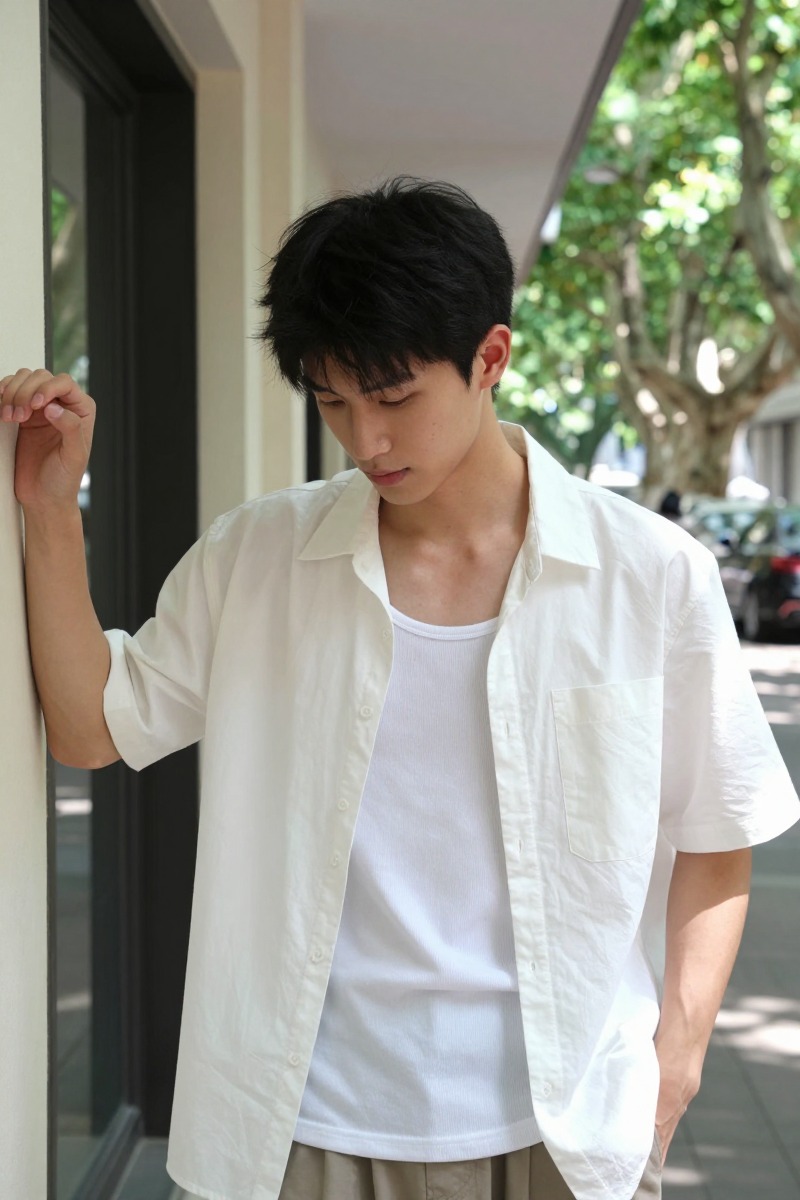
This is the category I would prioritize first. Milk-grey steps back more gently than pure white, while avoiding the dark-block problem of deeper grey. Fine ribbing feels more like clothing than glossy function fabric, but avoids the dated look of coarse ribbing. It works especially well inside white shirts, off-white open shirts, and pale grey shirts, and is one of the strongest directions for college-boy, library-core, café-core, and light cleanfit summer dressing.
2. Skin-tone or nude-feel smooth base tanks
If your first problem is transparency, this is the most direct route. These products usually stress words like invisible, nude-feel, anti-sheer, shirt inner layer, and summer base layer. Their advantage is obvious: they are highly effective under white shirts and pale tops. Their weakness is just as obvious: if the fabric is too shiny, too slick, or too function-coded, they start looking like cheap technical underwear. This category depends heavily on your ability to judge product photos.
3. Pale oatmeal cotton-feel tanks
This is one of the strongest directions for college-boy and light Korean casual dressing. It feels more like clothing than skin-tone function layers, yet remains far quieter than pure white. It pairs well with light-wash denim, off-white trousers, khaki shorts, canvas bags, and pale sneakers, especially for readers who want a more natural wardrobe language rather than a visible “solution garment.”
4. Low-contrast light-function tanks
If you move a lot, commute longer, or sweat more quickly, a lightly functional low-contrast route can also make sense. But only if it still looks like a youth-menswear foundation instead of gym innerwear. The versions worth buying usually control shine, logos, and compression, allowing them to sit inside cleanfit and light commuter wardrobes without dragging the whole outfit into sports-underwear territory.
Four search entries worth trying first
5. Nine checks before buying one
1. Does the color step back, or just look dirty?
Low contrast should not mean washed-out or lifeless. The best milk-grey and skin-tone shades feel calm and soft while still reading clean. The bad ones simply look old or tired.
2. The neckline should be low-presence, not collapsed
If the neckline sits too high, it still reads like a visible extra shirt under your outer layer. If it drops too low, it can look too much like underwear. The strongest versions usually sit close to the collarbone with a thin, clean edge.
3. Strap width decides whether it feels like clothing or underwear
Very narrow straps often slide toward underwear energy immediately. Very broad ones can start feeling like a tee with the sleeves removed. The strongest middle ground is one that works both under shirts and, in some cases, on its own.
4. Fabric needs low shine
This is one of the hardest filters. Even when the color is right, too much shine can make the whole thing look like bargain technical innerwear. This matters especially for skin-tone and nude-feel routes.
5. Lightness is not the same as safety
If the tank is so light that it behaves like a membrane, it may sound “advanced” on the product page but feel too clingy, too transparent, and too sweat-sensitive in real life. The versions worth buying are light, soft, and smooth while still holding a little structure.
6. Product pages should include layering with white shirts or pale outerwear
If a listing keeps calling itself “white-shirt inner layer” or “invisible base tank” but never shows the product under a white shirt, the selling point is weak. The best pages are willing to show the item in the very situations where it should prove itself.
7. Avoid listings that depend only on body shape and dramatic lighting
If the whole page only works because of muscles and low-angle chest lighting, it is not especially useful for ordinary daily dressing judgment. Natural posture, pale-shirt layering, and simple real-life styling are much more useful.
8. It has to connect to your actual outer layers
The best low-contrast tanks should work with your white shirts, pale short-sleeve shirts, open shirts, sun shirts, lightweight knits, and nylon outer layers — not only inside one highly staged image system.
9. It should feel like a quiet wardrobe foundation, not a gadget that needs a sales speech
The best basics on BoyStyle are understandable at a glance. The more a product needs a flood of “technology” language to justify itself, the more carefully you should check whether it will still make sense inside a real youth-menswear wardrobe.
6. Six low-risk ways to wear it
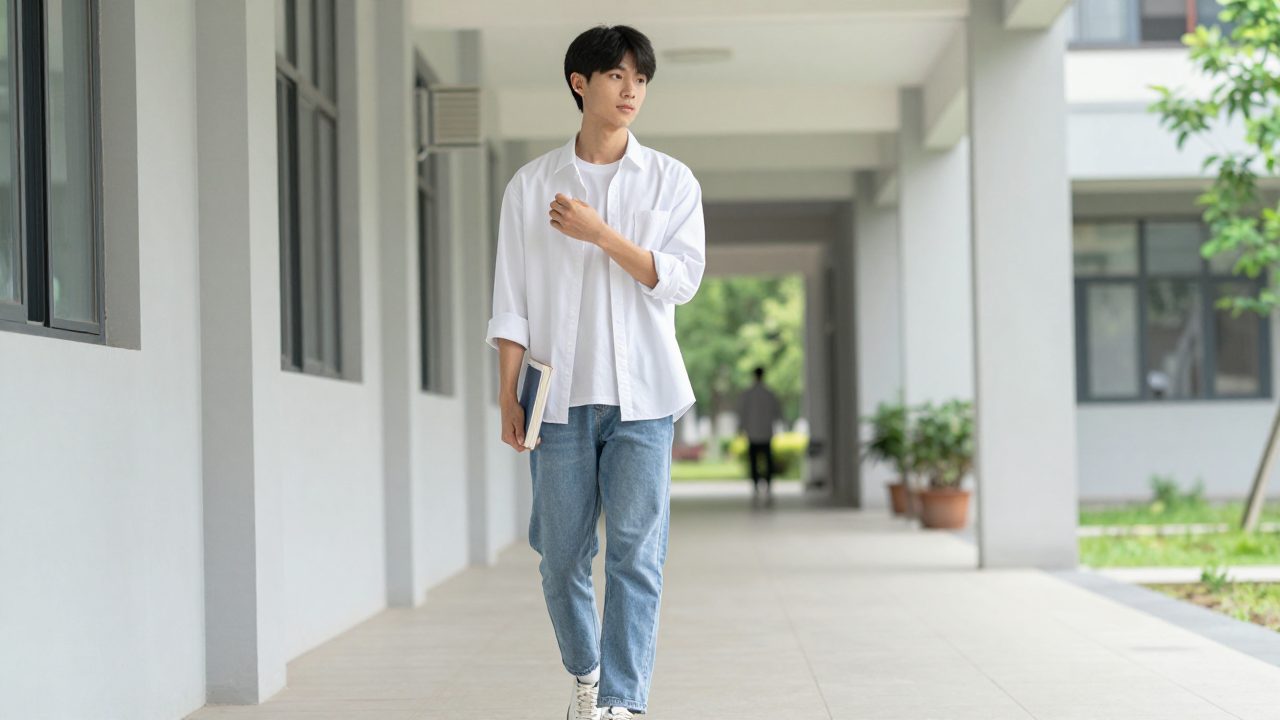
- Milk-grey tank + open white shirt + light-wash jeans: one of the cleanest college-boy formulas — lighter than a white tee, more stable than wearing the shirt against bare skin.
- Skin-tone base tank + off-white open shirt + khaki straight trousers: especially strong for cleanfit and low-noise spaces like libraries, cafés, and indoor shopping routines.
- Pale oatmeal tank + soft grey thin shirt + white trousers: ideal for light Korean casual dressing without becoming too formal or too function-coded.
- Milk-grey tank + nylon sun shirt + nylon shorts: useful for moving a lot and sweating faster, while letting the outer layer stay visually light.
- Skin-tone tank + fine-knit polo + tailored shorts: great for men who want the upper body to stay clean without letting a bright crewneck tee overload the collar area.
- Soft beige-grey tank + textured short-sleeve shirt + relaxed shorts: works especially well for malls, evening city walks, and summer situations that need completion without heaviness.
The shared logic is always the same: the low-contrast inner layer is not the hero. Its job is to let the outer layer finally behave like the outer layer, instead of looking like a thin garment draped over an obvious bright inner shirt.
7. Which store routes are worth checking first
Based on the current Chinese-internet buying mood, I would prioritize three store routes:
- Shirt- and open-shirt-oriented stores: these are more likely to understand that an inner layer should not interrupt the outer layer, and are often better at milk-grey, pale oatmeal, and soft low-contrast routes.
- Cleanfit / light-commuter basics stores: these are more likely to get neckline, strap width, color, and fabric finish right instead of defaulting to gym-tank logic.
- High-value basics-innerwear stores: useful when you want a more affordable shirt-layering solution, but you need to be stricter about product photos and fabric quality cues.
The smartest buying strategy is not memorizing a store name. It is finding the route that can connect with the outer layers you already own, and then deciding whether your budget should move upward or downward. For BoyStyle readers, the real risk with basics buying is not spending a bit more. It is buying something that cannot actually enter your wardrobe system.
If you have already read BoyStyle’s pieces on the non-sheer base-layer tee, why tank-style base layers are back, the basic logic of open-collar short-sleeve shirts, or why textured short sleeves feel more current than another basic white tee, this article is really the next step. It moves from asking whether you need an inner layer at all to asking whether you should update your whole inner-layer mindset from “pure white by default” to “low contrast by design.”
8. BoyStyle’s read on this low-contrast-inner-layer wave
The part of this 2026 Chinese-internet shift that matters is not simply that “milk-grey tanks are popular now.” It is that young men are finally taking seriously the layer most likely to decide whether a summer upper body looks complete or not. The value of a low-contrast inner layer is not that it feels especially new, dramatic, or technological. Its value is that it solves a very practical problem: white shirts, pale shirts, open shirts, and lightweight outer layers can finally work more cleanly without relying on a thick white tee or on wearing them over bare skin.
If you only want to add one category that genuinely improves summer upper-body efficiency, I would seriously suggest shifting at least part of your attention away from “another pure white inner tee” and toward milk-grey, skin-tone, pale oatmeal, and other low-contrast base-layer tanks. The conditions are still clear: the color should step back without looking dirty, the neckline and straps should stay quiet without collapsing, the fabric should be light but not glossy, and the product page should be brave enough to show the tank under white shirts and pale outer layers. If those things are in place, the piece stops being “just innerwear” and becomes one of the most useful high-frequency layers in a summer wardrobe.
Reference pattern: recent Chinese-internet discussion around “what to wear under a white shirt,” “how to wear pale shirts without transparency,” “stop stuffing bright white tees into thin shirts,” “milk-grey innerwear,” “skin-tone base layers,” “invisible tanks,” “men’s shirt inner layer summer,” and “cleanfit summer upper-body foundation”; plus Taobao / Tmall search paths such as “men tank milk-grey inner layer,” “men white shirt inner layer tank anti-sheer,” “men skin-tone base tank summer,” and “men shirt inner layer invisible tank cleanfit,” along with the product routes and image logic those searches now surface.