Sweatshirts and hoodies still own the youth-menswear middle layer
If the white tee is the base layer, the sweatshirt and hoodie are often the most stable middle layer in youth menswear. They are easier than shirts, less demanding than knitwear, more believable in daily life than many fashion-led tops, and far easier to wear repeatedly than many items that only look good in a single outfit photo. As long as Chinese-internet menswear keeps returning to college-boy style, campus dressing, sports-coded youth looks, cleanfit, and light commute styling, sweatshirts are not going anywhere.
The real question is not whether sweatshirts are outdated. It is which kind of sweatshirt or hoodie makes sense now. Fit, weight, hood shape, shoulder line, hem tension, visible inner layers, and how the garment shifts the wearer toward college-boy style, sportswear, cleanfit, or bland old Taobao menswear all matter.
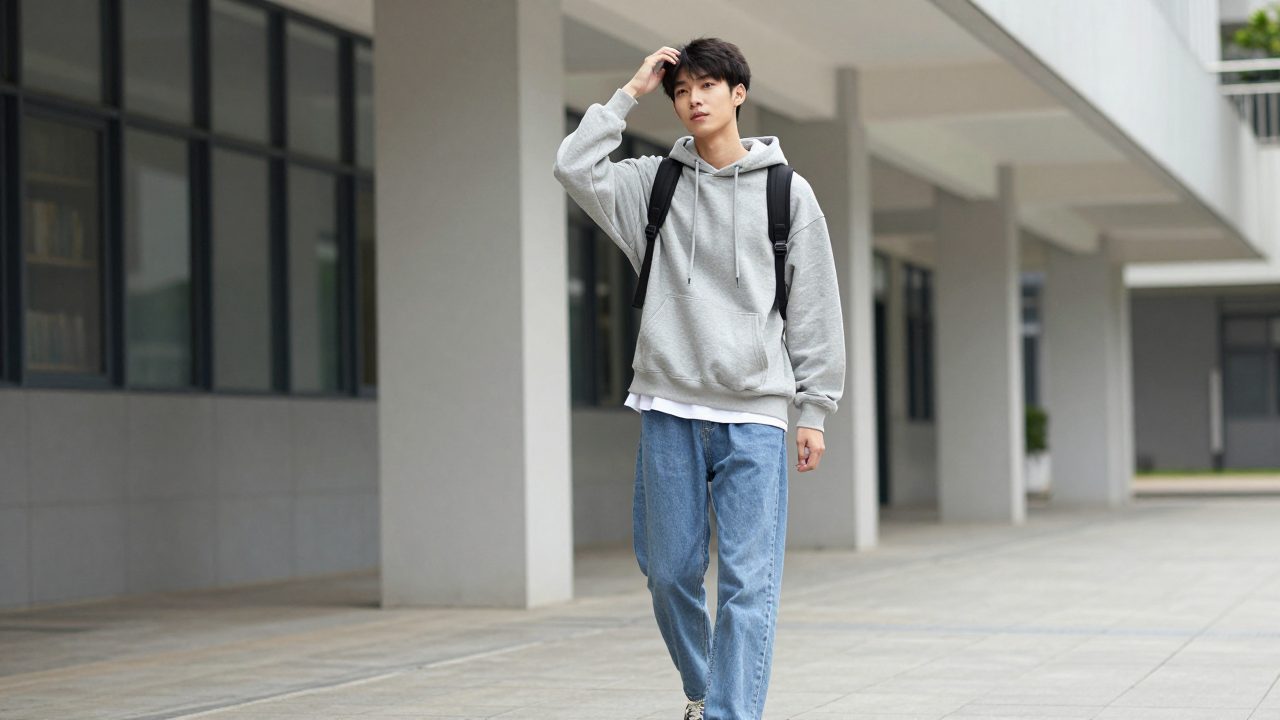
1. Why sweatshirts never really leave youth menswear
Because they are too close to real life. Some more “elevated” tops photograph beautifully but do not get worn enough. Some more obviously “fashion” pieces carry too much style pressure. Sweatshirts belong to ordinary movement: classrooms, libraries, convenience stores, subway stations, court-side steps, dorm entrances, rainy days, and transitional weather. They nearly always have a place.
They also do not force a single style reading. A sweatshirt can feel college-boy, cleanfit, Korean casual, sports-coded, or just basic and calm depending on the trousers, shoes, bag, and layering around it. That flexibility is why it survives every trend cycle.
2. Crewnecks, hoodies, and zip hoodies do not give the same mood
- Crewneck sweatshirts: the cleanest and most stable for college-boy style and softer cleanfit wardrobes.
- Pull-over hoodies: the strongest for sports-coded youthfulness and daily campus realism.
- Zip hoodies: excellent for transitional weather, inner-layer visibility, and light commute or sports-campus crossover dressing.
For BoyStyle, all three matter, but crewnecks and classic hoodies still carry the clearest youth value because they sit so naturally inside campus and daily-movement imagery.
3. Why the old heavy “Taobao hoodie” shape no longer works
A lot of readers still think thicker automatically means better. But overly heavy fleece, giant rigid hoods, excessive shoulder width, too-long bodies, and tight hems often create that old, clumsy Taobao menswear silhouette that looks both heavy and dated.
The hoodies that feel stronger now usually work because:
- the shoulder drops naturally without becoming absurdly oversized
- the hood has structure without turning into a giant shell
- the hem still has some natural fall
- the fabric feels substantial without becoming visually suffocating
In other words, the best hoodie silhouette now should feel formed, not forced.
4. Why hoodies work so well for college-boy and campus-sports imagery
Hoodies naturally carry a low-pressure kind of youthfulness. White tees can feel too basic. Shirts can feel too deliberate. Knitwear can feel quieter and more controlled. Hoodies sit in the middle. They can look like a real college boy, a dorm-to-library outfit, a court-side pause, or a slightly internet-native campus snapshot.
The hood itself helps a lot. It adds sports memory, campus realism, and social-media plausibility. Many strong college-boy images work not because the person is simply young, but because the clothes look like they belong to that age, place, and temperature. Hoodies do that especially well.
5. The relationship to trousers matters more than the color
Many readers shop hoodies by color first, but the final effect often depends more on the trousers. Pair a hoodie with the wrong skinny trouser and the body becomes unbalanced. Pair it with overly heavy cargos and the whole look can go dull. Pair it with clean straight trousers, relaxed jeans, training shorts, or a compression-layer setup, and the hoodie suddenly starts making real sense.
- hoodie + light-wash jeans: one of the cleanest college-boy formulas
- sweatshirt + straight trousers: stronger for cleaner, calmer cleanfit dressing
- hoodie + training shorts or compression-layer shorts: stronger for athlete-coded campus sportswear
- zip hoodie + joggers or light utility trousers: ideal for campus-sports crossover and low-stakes commute dressing
6. Color: grey is still the strongest, navy and black the most practical, oatmeal and off-white the cleanest
Grey hoodies and sweatshirts almost always work. They remain one of the strongest foundations in youth menswear because they look sporty without becoming loud. Black and navy are more practical and more seasonally stable, but can also make the whole look feel heavier. Oatmeal, off-white, and pale grey-white often feel lighter and cleaner in spring and campus contexts.
The biggest danger is dirty-looking color, harsh neon, outdated graphics, or print-heavy surfaces that age the garment immediately.
7. The most common mistake is not “wearing a hoodie,” but being swallowed by it
When hoodies fail, it is often because the person disappears inside them. The hood is too big, the body too long, the fabric too heavy, the hem too tight, the shoulders too wide. The whole upper body starts to look like a shell rather than a body inside clothing.
That is why real on-body judgment matters so much. Standing, sitting, lifting an arm, carrying a bag, turning, lowering the head — if the hoodie still behaves well across these states, it is probably a good one.
8. The most dependable image formulas
- hoodie + backpack + campus walkway: the clearest real college-boy daily image
- crewneck sweatshirt + visible white tee hem + jeans: one of the cleanest and easiest youth formulas
- zip hoodie + crossbody bag + glass corridor or transit passage: strongest for light commute youth dressing
- hoodie + training shorts + court-side setting: strongest for campus-athlete crossover
These images show that sweatshirts are not defined only by comfort. They are one of the best tops for holding together believable youth settings.
Continue with: why the grey hoodie remains such a stable cleanfit and college-boy layer, why jeans remain so hard to replace in youth menswear, and why compression shorts and training shorts became fixed layers in athlete-coded dressing