Why Delivery and Food-Runner Uniforms Suddenly Look Good: From Meituan to On-Demand Rider Jackets as Urban Utility Style
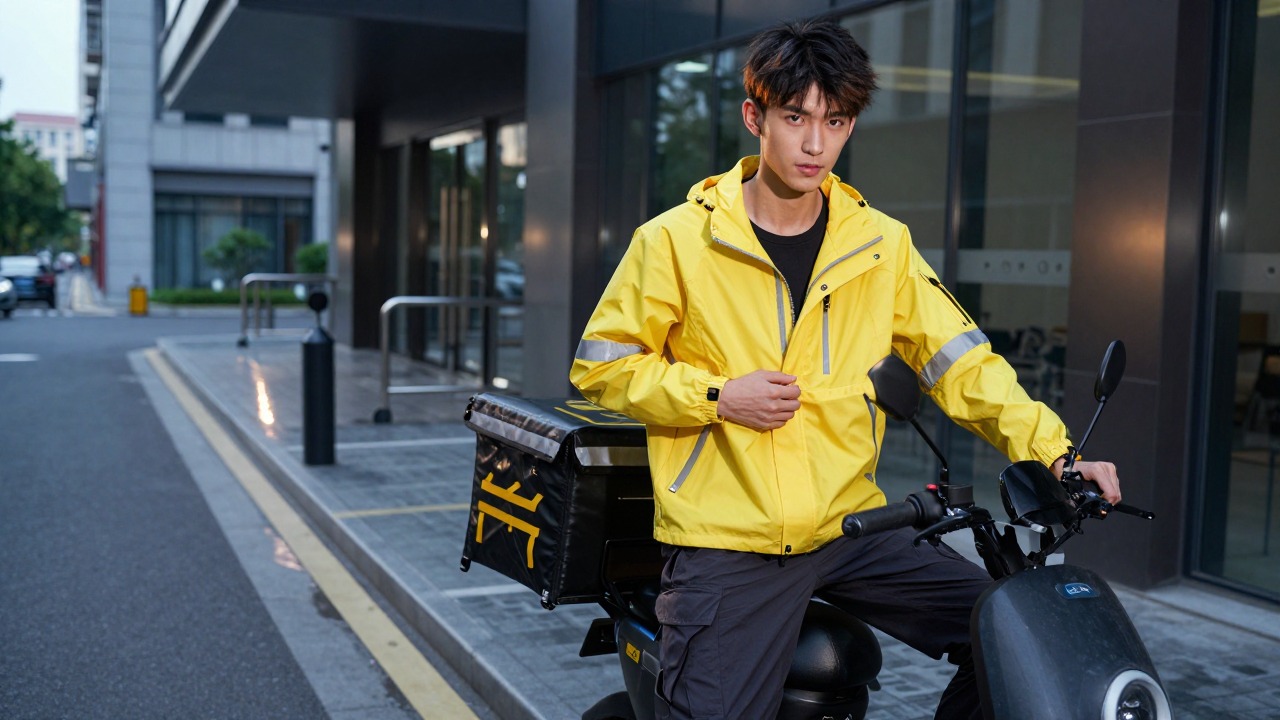
If you go back a few years, most people still treated courier and food-delivery uniforms as purely functional clothing: issued by a platform, built for work, useful but not especially aesthetic. That has clearly changed. More and more people now admit that Meituan uniforms actually look good, and that same-day or instant-delivery rider jackets often carry a sharp motorcycle-like utility appeal. These uniforms are no longer read only as job gear. They are starting to function as a very visible form of urban utility style.
That shift is not surprising. Platform uniforms naturally combine several things contemporary youth menswear already cares about: high recognizability, clear occupational identity, real commuting and riding logic, weatherproof technical fabric, reflective details, strong color blocking, and the body language of actual movement through the city. Once those elements gather in one place, the clothing easily upgrades from “work uniform” into “occupational style image.” What people respond to is not just a jacket. It is an entire visual system built from urban speed, service work, and functional structure.
1. Why platform uniforms entered menswear taste so suddenly
The most direct reason is that contemporary menswear increasingly values real function. Many styles used to begin inside fashion and then flow back into life. Platform uniforms do the opposite. They were born completely out of life and labor, yet because they are so real, so useful, and so tightly connected to the structure of city living, they loop back into aesthetic judgment. They were never designed as lookbook clothing, and that is exactly what makes them feel convincing.
In platform-era cities, couriers and delivery riders are also among the most visible working bodies in public space. They are always in motion: riding, waiting at lights, entering elevators, stopping at gates, moving between office towers and residential compounds. The uniform no longer belongs only to a closed job site. It keeps appearing across the whole city, where it is constantly seen, recognized, and reinterpreted. Once that happens often enough, it naturally becomes part of style culture.
2. Why Meituan uniforms are often read as “good-looking”
Meituan uniforms do not feel visually effective because they are secretly high fashion. They work first because they are extremely clear. Yellow is a high-visibility color by nature. Against the gray tone of city space, it jumps out immediately and creates both efficiency and identity. Once it is grounded by black, navy, or another dark neutral layer, the color relationship actually feels very contemporary: highly visible, but not visually complicated.
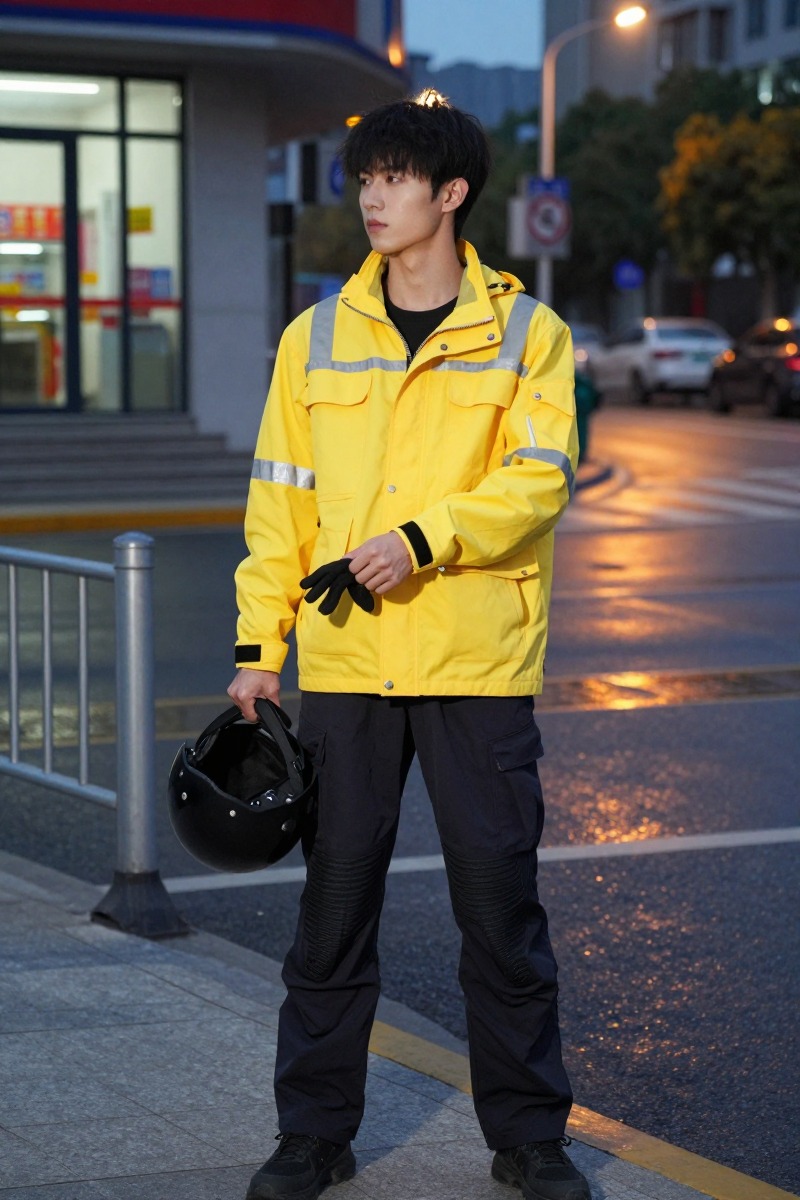
Even more important, Meituan uniforms now form an instantly recognizable full occupational image: helmet, windbreaker-like or shell-like outerwear, reflective strips, ID tag, delivery box, phone mount, gloves, trousers, and sneakers. Together, these elements suggest speed, execution, familiarity, and the high-frequency movement of urban service systems. So when people say they look good, they are not responding only to color. They are responding to the completeness of the occupational logic.
3. Why on-demand rider jackets often feel more “motorcycle-coded”
Compared with uniforms built around a stronger platform-identity color, some instant-delivery and rider jackets more easily read as motorcycle or technical-commuter outerwear. That is because they often emphasize wind resistance, waterproofing, night visibility, abrasion resistance, and fast on-off utility. Their silhouette also tends to sit closer to functional shells or rider jackets than to conventional workwear.
Once that kind of outerwear leaves its strict work context and enters broader urban style culture, people can easily connect it to motorcycles, riding, night roads, rain movement, technical fabrics, and the visible male body in motion. It does not create attraction through dignity and etiquette like traditional service uniforms. It works through momentum, efficiency, and the credibility of real-use wear. For youth menswear, that is a fresh occupational image.
Why Platform Uniforms Can Look So Good
4. Why these uniforms can feel “handsome”
What people read as “handsome” here is not only conventional visual attractiveness. It is occupational movement turned into style. Rider and courier uniforms often feel compelling because they are tied directly to action. The wearer is not simply displaying a look. He is executing: taking the order, moving through traffic, waiting at lights, finding the building, going upstairs, delivering, and heading back out again. That task structure gives the clothing a built-in rhythm.
In other words, the attraction lies in the combination of clothing, task, body, and city. The more often a form of workwear appears in real life, the easier it becomes to develop a kind of unforced credibility. It is not as stage-managed as fashion imagery, but precisely because it is not trying so obviously to look stylish, its real visual force becomes easier to notice.
5. Why this has become a new kind of “urban occupational style”
Platform uniforms became style objects because they sit exactly at the intersection of several modern aesthetic lines: uniform culture, urban utility wear, rider aesthetics, service-role imagery, brand-color systems, and high-frequency moving work bodies. They are no longer only labor garments. They have become one of the most visible modern professional silhouettes inside the city.
And unlike more traditional uniforms, they are extremely close to everyday life. Pilots, cabin crew, and hotel concierges all carry strong occupational aesthetics, but most people do not see them every day. Delivery workers do. Couriers and food runners are now among the most constantly visible work identities in urban life. That visibility makes their uniforms especially easy for the public to re-read and aesthetically reevaluate.
6. Where the trend value comes from
A lot of people assume trend value must begin with designers or brands. Platform uniforms suggest another route: trend value can emerge when a purely functional system gets watched often enough. Reflective strips, high-visibility panels, technical outer shells, weatherproof fabrics, utility pockets, rider posture, and a sharply managed color system—once those elements become stable enough, they automatically form a visual order. Fashion always knows how to borrow from visual order.
So the trend value of platform uniforms does not necessarily come from looking like streetwear or luxury fashion. It comes from their overlap with many current style keywords: city, speed, technology, outer-layer logic, occupational visibility, young male motion, night travel, and instant response. Once those combine, the uniform stops being just labor gear. It starts to feel like a style prototype naturally produced by real urban life.
7. The most common misunderstanding: seeing only color, not system
If platform uniforms are reduced to “that yellow looks good” or “that jacket looks motorcycle-like,” the most important thing gets missed. What really makes them work is the whole system: helmet, shell, trousers, shoes, delivery box, phone mount, posture, route, stopping gesture, weather, even time of day. It is a complete occupational role, not a single fashion item.
That is why simply extracting a few of these elements into everyday clothing does not automatically create the same effect. The attraction comes from seeing the system activated by work, not from copying one visual cue in isolation. The aesthetic value of platform uniforms lies in their occupational completeness.
8. Why this type of uniform will likely keep influencing youth menswear
Because youth menswear is always searching for new sources of real style. In the past that may have meant campus, sports fields, outdoor scenes, nightlife, or music venues. Now urban delivery systems have become another source. They represent not old-fashioned elegance, but a platform-era working body: instant response, cross-space movement, strong dependence on functional gear, high-frequency execution, and constant visibility inside the city.
That is also why this kind of uniform will probably keep influencing menswear: stronger visibility color, clearer reflective detailing, more technical outer-layer construction, silhouettes closer to rider gear, and city utility looks more directly tied to role. Designers may not even need to invent the style. Real life has already done much of the work.
9. If I kept only one stable principle for reading platform uniforms
If I had to leave BoyStyle with one key judgment here, it would be this: what makes platform uniforms look good is not that they imitate fashion, but that they turn role, speed, service, and function into a highly visible urban image. Once you see that, it becomes easy to understand why Meituan uniforms feel visually strong, why rider jackets can seem sharp, and why these occupational clothes have moved from pure labor gear into style objects.
Because what they ultimately produce is not just a branded jacket. They produce a professional silhouette of the current era: young, fast, direct, function-first, and always in motion. The clothing does not only block wind and rain. It wears the tempo of platform labor and the body aesthetics of the city on the outside.
Read next: Why formalwear and uniforms remain compelling, Why cycling fashion is becoming one of the most body-driven style lines, Why military style keeps returning to youth menswear, Why light jackets remain structurally central in transitional youth menswear
Source model: Chinese-internet discussion around Meituan uniforms, delivery-rider jackets, instant-delivery utility outerwear, urban utility style, occupational uniforms, and platform-era work imagery; plus broader public re-reading of high-visibility service clothing and technical delivery gear.